The decision between a steel sprocket and a plastic (polymer) sprocket is one that engineers encounter more frequently than catalogue structures suggest. Most industrial sprocket catalogues are dominated by steel, which creates the impression that plastic is a niche or compromise option. In practice, engineering plastics — particularly nylon, acetal (POM), and ultra-high-molecular-weight polyethylene — are specified as the preferred material in specific, well-defined application types where steel would actually perform worse. The key is knowing exactly which conditions favour each material, and where the boundaries between them lie.
This article provides a direct, evidence-based comparison of steel and plastic sprockets across the dimensions that matter most in industrial drive selection: load capacity, corrosion resistance, noise, lubrication requirements, temperature limits, chemical resistance, and total cost of ownership. It also identifies the applications where each material is clearly the right answer and the borderline cases where the decision requires engineering judgment.
Steel Sprockets: Capabilities and Inherent Limits
Steel is the dominant sprocket material for straightforward reasons: high tensile and yield strength, excellent fatigue resistance under cyclic loading, the ability to be hardened at the tooth surface while remaining tough at the core, and a long track record in demanding applications across virtually every industry. Industrial chain sprockets in carbon steel C45 with high-frequency induction hardening remain the first choice for the majority of industrial chain drive applications, from agricultural main drives to heavy-duty conveyor head stations.
The limits of steel in sprocket applications are primarily environmental rather than mechanical. Steel corrodes in wet, humid, or chemically aggressive environments unless protected by a surface coating — and surface coatings at the tooth contact zone wear off quickly under roller-to-tooth contact loads, exposing bare steel to the environment. In food processing, pharmaceutical production, and any application where the sprocket is regularly washed down with detergents or acids, an uncoated or coated carbon steel sprocket fails from corrosion within months under conditions where a stainless steel or polymer sprocket would last for years.
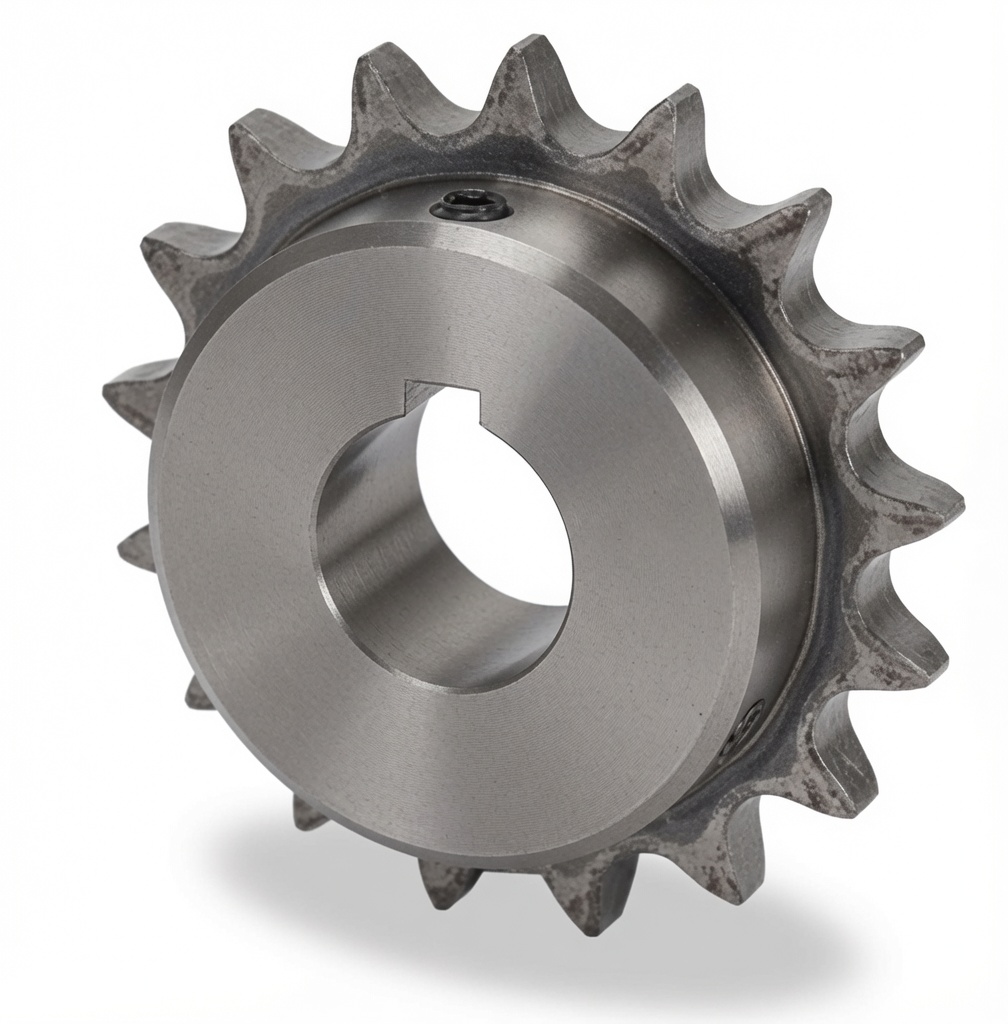
Engineering Plastic Sprockets: What They Are and How They Work
Engineering plastic sprockets are manufactured from high-performance polymer materials — most commonly nylon 6, nylon 66, acetal homopolymer (POM-H), acetal copolymer (POM-C), or UHMW-PE. These materials have tensile strengths ranging from 50–85 MPa (compared to 600+ MPa for hardened C45 steel), which means a plastic sprocket of the same dimensions as a steel sprocket carries significantly less load. However, the relevant comparison is not load capacity in isolation — it is the balance of all performance properties including weight, self-lubrication, noise generation, chemical resistance, and impact behaviour.
Most engineering plastic sprockets are self-lubricating: the polymer matrix itself has a coefficient of friction against steel chain rollers significantly lower than steel-on-steel contact, and this low-friction interface means the chain rollers seat and disengage with less friction heat and less wear on both the tooth surface and the roller surface. In lightly loaded drives where lubrication access is difficult or prohibited — food equipment under hygiene regulations, laboratory instruments, textile machinery — this self-lubrication property of plastic sprockets is a genuine performance advantage rather than a compromise.
Direct Property Comparison: Steel vs Plastic Sprockets
| Property |
Carbon Steel C45 |
Stainless Steel 304 |
Nylon 66 |
Acetal (POM) |
| Tensile strength |
600–800 MPa (HF-Q) |
515 MPa min |
80–85 MPa |
65–70 MPa |
| Tooth surface hardness |
40–50 HRC (HF-Q) |
Rb 80–90 |
Shore D 80–85 |
Shore D 80–85 |
| Max load capacity |
Very high |
High |
Low–moderate |
Low–moderate |
| Self-lubricating |
No |
No |
Yes (partial) |
Yes (excellent) |
| Corrosion resistance |
Poor (bare) |
Excellent |
Excellent |
Excellent |
| Water absorption |
None |
None |
High (nylon) |
Very low (acetal) |
| Max operating temp. |
~300 °C |
~300 °C |
~120 °C |
~100 °C |
| Chemical resistance |
Limited |
Good |
Good |
Excellent |
| Noise generation at speed |
Moderate |
Moderate |
Low — dampens vibration |
Low |
| Weight |
Heavy (~7.8 g/cm³) |
Heavy (~7.9 g/cm³) |
Light (~1.15 g/cm³) |
Light (~1.41 g/cm³) |
| Impact resistance |
High (ductile) |
High (ductile) |
Good |
Moderate |
| Max chain speed |
Very high |
Very high |
Moderate (~2 m/s) |
Moderate (~2 m/s) |
| Cost per unit |
Low–moderate |
Moderate–high |
Low–moderate |
Moderate |
Where Plastic Sprockets Perform Better Than Steel
There are specific, identifiable conditions where an engineering plastic sprocket is not a compromise but the genuinely better engineering choice. Engineers who understand these conditions specify plastic without hesitation; those who default to steel in all cases incur unnecessary maintenance costs.
Low-Load, Quiet-Running Conveying
Supermarket checkout conveyors, textile machinery, and printing equipment operate at low chain loads where the lower tensile strength of plastic is never approached. Plastic sprockets in these drives run quieter than steel — the polymer damps vibration rather than transmitting it — and require no lubrication, which eliminates a maintenance task and a contamination risk.
Food-Contact Zones Without Lubrication Access
Certain food equipment zones prohibit lubricant of any kind at the chain drive — direct-contact zones in confectionery, bakery, and fresh-produce handling, for example. A self-lubricating acetal sprocket running on a stainless steel chain operates without added lubricant in these zones, where a steel sprocket would wear rapidly due to dry running.
Corrosive Atmospheres Where SS Is Too Expensive
Chemical processing plants, saltwater environments, and wastewater treatment facilities expose drives to corrosive vapours and liquids. Where 304 stainless steel is cost-prohibitive and 316L is even more so, engineering plastic sprockets provide excellent chemical resistance for light-to-moderate loads at significantly lower material cost.
Drives Requiring Electrical Isolation
Electrostatic discharge (ESD) or electrical isolation requirements in electronics manufacturing, explosive atmospheres, or high-voltage equipment can be addressed by using plastic sprockets, which are inherently non-conductive. Anti-static variants with controlled surface resistivity are available for ESD-controlled environments.
Weight-Critical Portable Equipment
Agricultural hand tools, portable machinery, and any equipment where total weight matters benefit from plastic sprockets that weigh 80–85% less than equivalent steel. In a device with dozens of sprockets, the cumulative weight saving from plastic is significant.
Where Steel Sprockets Are Clearly Superior
For the majority of industrial drives, drive chain sprockets in steel outperform plastic on every metric that matters for the application. The following conditions favour steel unambiguously.
High-Load Power Transmission
Any application where chain tension approaches or exceeds the safe working load of the available plastic grades — typically above 500 N on small plastic sprockets or above 2,000 N on large ones — must use steel. The strength difference between hardened C45 steel and the best engineering plastics is a factor of 5–10, which cannot be designed around at high loads.
High Chain Speed
Above approximately 2 m/s chain speed (approximately 400 ft/min), the contact stress and friction heat at each roller-tooth engagement cycle exceed the safe working range of most engineering plastics. Steel handles chain speeds up to 30 m/s and beyond without thermal degradation.
Shock and Impact Loading
Agricultural combines, mining equipment, and construction machinery subject their drives to severe shock loading — sudden load spikes from stone ingestion, material jamming, and machine start-stop cycles. Engineering plastics are brittle relative to steel under impact and can fracture without warning under shock loads that steel would absorb without damage.
High Temperature Environments
Conveyor drives in industrial ovens, dryers, and furnaces operate at temperatures that exceed the maximum service temperature of most engineering plastics (80–120 °C). Steel operates reliably at these temperatures without loss of mechanical properties.
Long Uninterrupted Service Life
In drives that must run for 5–10 years between major overhauls — mining conveyors, continuous process lines, power plant auxiliary drives — the superior fatigue strength and wear resistance of hardened steel extends the maintenance interval far beyond what plastic can achieve at equivalent load levels.
The Boundary Zone: When the Decision Is Not Obvious
Between the clear-cut cases lies a band of applications where load is moderate, speed is medium, and the environmental factors could argue for either material. In this zone, the decision comes down to which performance deficiency is more tolerable: the corrosion vulnerability of steel or the load-capacity limitation of plastic. For food grade chain sprockets at moderate loads in hygienic environments, stainless steel typically wins when the load approaches even half the plastic limit, because the cost of a failed plastic sprocket in a food facility — production stoppage, potential contamination, regulatory inspection — vastly exceeds the cost difference between stainless steel and plastic sprockets.
Decision Rule for the Boundary Zone: Calculate the actual working chain tension in the drive. If it exceeds 30% of the plastic sprocket’s rated load, use stainless steel. If it is below 20% and the environment prohibits lubrication or demands light weight, engineering plastic is the better choice.
Need Industrial Sprockets? Get a Factory-Direct Quote
Hangzhou Ever-Power manufactures stainless steel, carbon steel, and custom chain sprockets for global industrial buyers. Low MOQ, full documentation, fast lead times from Hangzhou, China.
SHENHUA ROAD, HANGZHOU, CHINA | +86-571-88220653
Frequently Asked Questions
1. Can I run a steel chain on a plastic sprocket?+
Yes, and this is the standard configuration for plastic sprockets. The lower surface hardness of the plastic tooth seat actually reduces roller wear on the steel chain — the softer tooth face conforms slightly to the roller under load, distributing contact stress rather than concentrating it. Plastic-sprocket / steel-chain drives are used routinely in food equipment, light conveyors, and packaging machinery.
2. What happens to a nylon sprocket when it absorbs moisture?+
Nylon (polyamide) absorbs moisture from the environment, and moisture absorption causes dimensional changes — typically 0.5–1.5% linear expansion — and a reduction in tensile strength and stiffness. For precision drives, this dimensional change can affect chain engagement quality. Acetal (POM) absorbs far less moisture than nylon and is preferred for applications where dimensional stability in humid environments is required.
3. Is a plastic sprocket food-safe?+
Most engineering plastics used for sprockets — nylon, acetal, UHMW-PE — are available in food-grade grades compliant with FDA 21 CFR and EU 10/2011 food contact material regulations. Always confirm the specific grade used by the manufacturer complies with the relevant food contact standard for your application region.
4. Can plastic sprockets be used outdoors in UV-exposed applications?+
Standard nylon and acetal grades degrade under prolonged UV exposure, becoming brittle and losing load capacity over 12–24 months. UV-stabilised grades are available that extend outdoor service life significantly. Steel sprockets (coated or stainless) are inherently UV-immune and are generally the safer choice for outdoor exposed drives at any significant load.
5. How do I tell if my drive load is within the safe range for a plastic sprocket?+
The safe approach is to calculate the chain tight-side tension from the drive power and speed (T = P / v, where P is power in watts and v is chain speed in m/s), then compare to the rated load of the specific plastic sprocket at the operating chain speed. Plastic sprocket catalogues list load-speed curves rather than single load ratings because plastic fatigue strength is speed-dependent. If the calculated tension exceeds 50% of the rated load at your operating speed, use steel.
Hangzhou Ever-Power Sprocket Chain Co., Ltd.
