
In sprocket engineering, the term “plate sprocket” refers to a flat-disc sprocket without a projecting hub — what catalogue standards call Type A — while a hubbed sprocket has one or two cylindrical boss extensions on the face or faces, providing additional shaft engagement length and set-screw or keyway accommodation. This distinction maps directly onto the Type A versus Type B/C hub type system described in ANSI and BS/DIN sprocket standards, but the plate/hubbed terminology is more commonly used in the field and in many manufacturer catalogues, particularly for larger sprockets at heavy pitches where the plate configuration is a meaningful alternative to the hub design.
The practical question for an engineer specifying a sprocket for a new machine or selecting a replacement part is: when does the plate configuration offer a genuine advantage over a hubbed sprocket, and when does the hub — despite adding axial width and manufacturing cost — provide performance that the plate cannot match? This article works through that question systematically.
What Is a Plate Sprocket?
A plate sprocket (Type A) is a sprocket manufactured without any hub projection on either face. The sprocket body is essentially a disc of constant width from the bore to the tooth tips, with teeth machined or hobbed on the outer circumference and a central bore through the disc. The bore diameter occupies the full width of the disc body — there is no additional engagement length beyond the sprocket face width itself. Power transmission chain sprockets in plate configuration are found primarily in two roles: as freely running idler sprockets, and as drive sprockets where a separate, independently mounted hub provides the shaft engagement.
Large-diameter plate sprockets at heavy pitches — 17-inch-diameter 60-tooth sprockets at No.60 chain, for example — are often manufactured as plate type because the large OD and the relatively low hub engagement length make the plate design more practical to manufacture from plate material or ring forgings than the equivalent hubbed design would be from billet. At these sizes, the hub engagement length is provided by a separately machined split hub or a welded-on boss that is fitted to the sprocket plate rather than machined integrally.
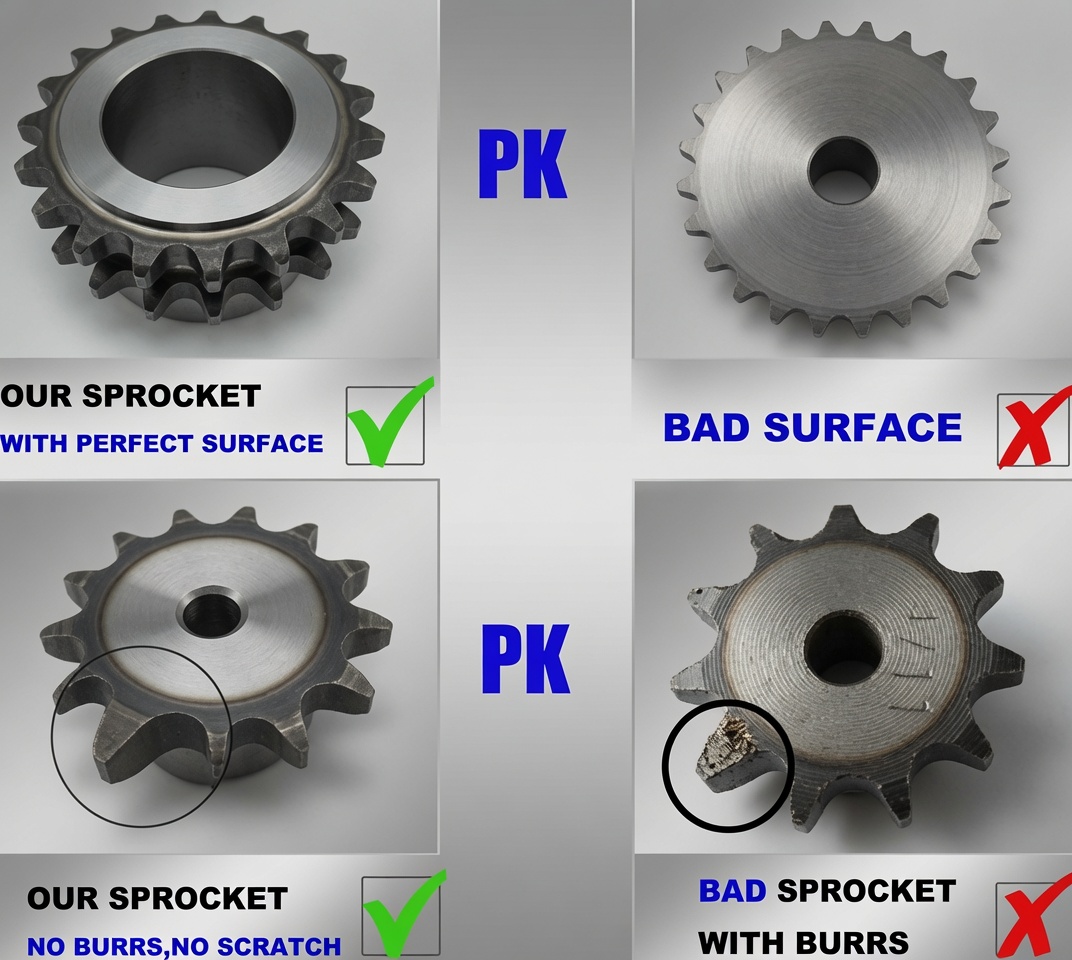
What Is a Hubbed Sprocket?
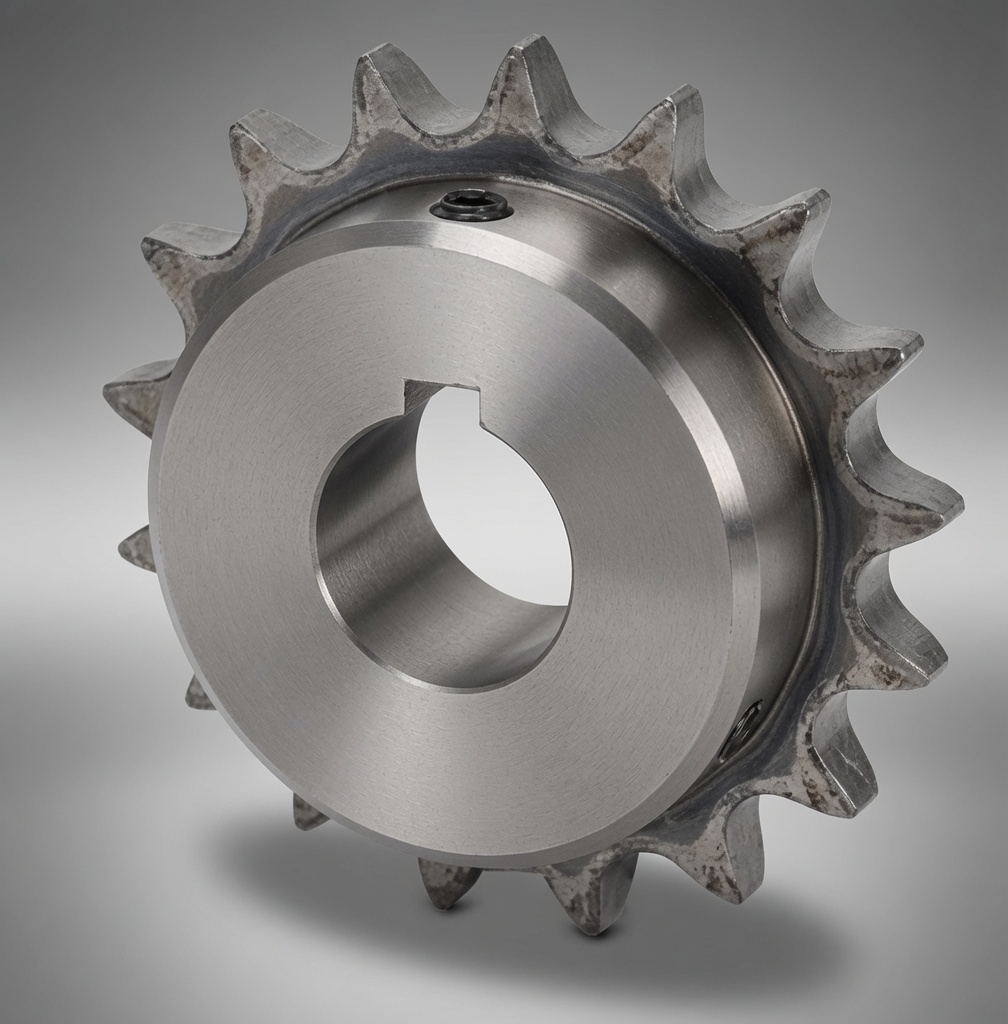
A hubbed sprocket (Type B or Type C) has one or two cylindrical hub projections extending beyond the sprocket face. The hub contains the primary bore machining, the keyway, and the set-screw boss that attach the sprocket to the shaft. The additional length of the hub (beyond the sprocket face) provides shaft contact length that improves the distribution of torque from shaft to sprocket, resists rocking under asymmetric chain loads, and provides additional material for the keyway shear area. The vast majority of standard stainless steel sprockets in catalogue configurations are hubbed — Type B single hub is the default for most tooth counts and pitches because it provides the shaft engagement needed for direct keyed mounting without excessive axial width.
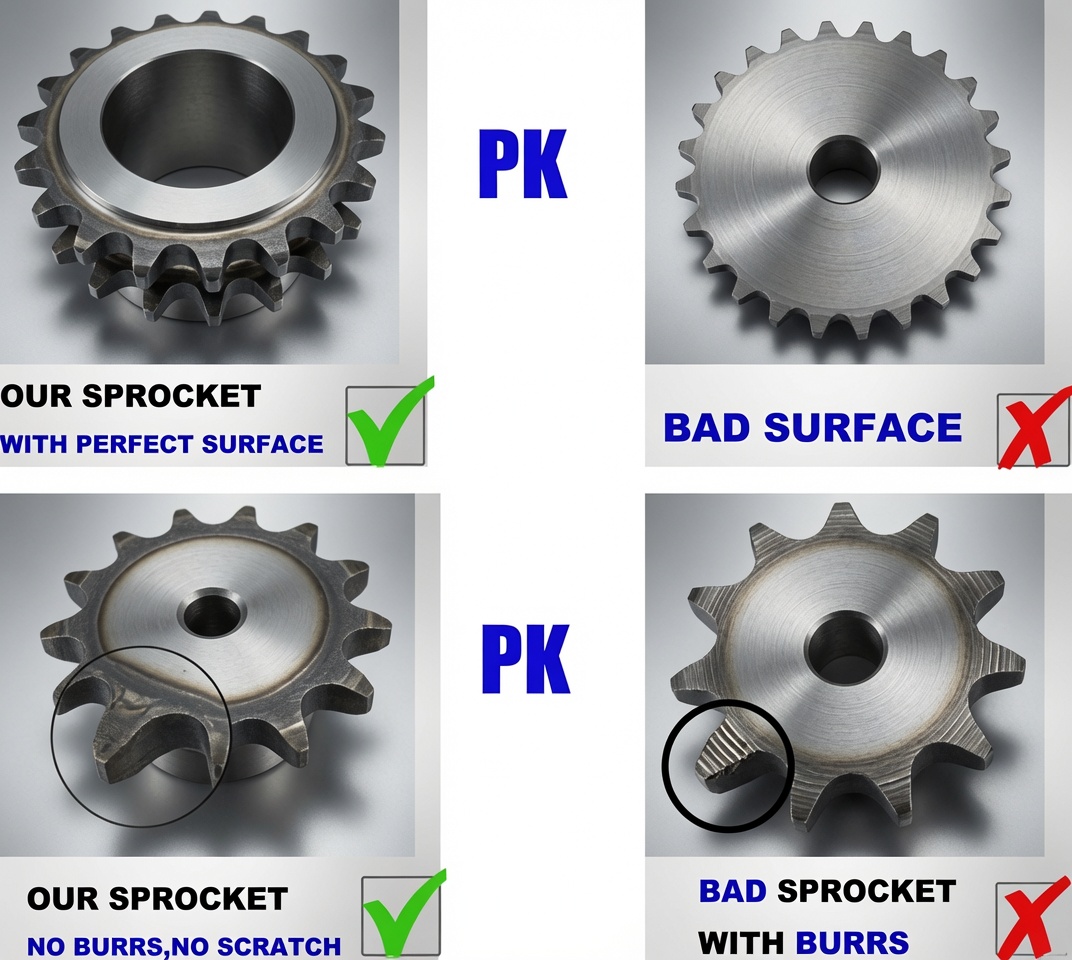
The Engineering Differences: Hub vs No Hub
| Parameter | Plate Sprocket (Type A) | Hubbed Sprocket (Type B / Type C) |
|---|---|---|
| Hub projection | None — flat disc | One or both faces — cylindrical boss |
| Shaft contact length | Face width only (typically 1/2″ to 1-1/2″) | Face width + hub projection (up to 3×+ face width) |
| Keyway provision | Usually none, or machined to full disc width | Standard — machined in hub to full depth |
| Set-screw provision | Usually none | Standard — threaded into hub body |
| Bore-to-tooth concentricity | Equals machined bore quality | Equals machined bore quality |
| Torque capacity (direct mount) | Limited by short contact length | Full — hub length provides adequate engagement |
| Axial width | Minimum — face width only | Face width + hub(s) |
| Use in tight lateral spaces | Preferred — narrowest configuration | Hub may create interference |
| Use as idler | Common — no keyway needed | Acceptable but wider than necessary |
| Available at large diameters | Common (ring/plate construction) | Available; machined from larger billet or forging |
| Cost at large sizes | Lower — plate material, less machining | Higher — larger billet, more machining |
When the Plate Configuration Is the Right Choice
Three specific situations genuinely favour the plate sprocket over a hubbed equivalent. Outside these three situations, a hubbed sprocket is almost always preferable because it provides shaft mounting security that a plate sprocket cannot match through direct bore mounting. Metric chain sprockets in flat-disc configuration are supplied by our facility for the following applications:
When the Hubbed Configuration Is the Right Choice
For any application where the sprocket is directly keyed and secured to the shaft — which includes the large majority of drive and driven sprockets in standard industrial machinery — the hubbed configuration is essential. The hub serves three structural functions simultaneously: providing adequate shaft contact length to distribute keyway shear stress, providing material for the set-screw boss that prevents the sprocket from walking axially on the shaft under side loads, and providing a physical stop that determines the axial position of the sprocket on the shaft without requiring a separate collar or shoulder.
The minimum shaft contact length required for a keyed connection is typically 1.0× to 1.5× the shaft diameter. For a 1-inch shaft diameter, this means 1.0″ to 1.5″ of engagement length. A plate sprocket at No.40 chain typically has a face width of 0.62″ — less than the minimum engagement length for a 1-inch shaft. The hub of a Type B sprocket adds 0.5″ to 1.5″ of engagement beyond the face, bringing the total contact length within the required range. For heavy duty roller chain sprockets at No.60, No.80, and No.100 pitch on large-diameter shafts, the hub length requirement scales proportionally — which is why large-pitch Type C double-hub sprockets exist.
Large-Diameter Plate Sprockets: A Special Manufacturing Case
For very large sprockets — diameters above approximately 24 inches, typically at No.60 pitch and above — manufacturing from a solid billet becomes impractical or uneconomical. The preferred approach is to fabricate the sprocket from a steel ring (for the tooth OD section) welded or bolted to a separate hub or plate centre. This results in a sprocket that is physically a “plate” design at the tooth ring level, with the hub being a separately machined insert or weld-on boss. These large fabricated sprockets combine the plate structure at large diameter with hub engagement at the bore — they do not fit neatly into the Type A/B/C classification but are better described as “fabricated sprockets” or “built-up sprockets.”
Our factory produces fabricated large-diameter sprockets in carbon steel and stainless steel from custom drawings. For conveyor head sprockets above 18″ diameter at heavy chain pitches, the fabricated construction is often the most economical approach for quantities below the minimum that would justify dedicated forging tooling.
Selecting Between Plate and Hubbed: A Decision Summary
Hangzhou Ever-Power manufactures stainless steel, carbon steel, and custom chain sprockets for global industrial buyers. Low MOQ, full documentation, fast lead times.
SHENHUA ROAD, HANGZHOU, CHINA | +86-571-88220653