
Pitch is the single most important dimension in any chain-and-sprocket system. Get it right and everything else — tooth count, bore, hub type, material — can be worked through methodically. Get it wrong and the chain will not engage the sprocket at all, or will engage so poorly that both components fail within hours. Despite this centrality, “pitch” is one of the most misunderstood dimensions in chain drive engineering, partly because the same word is used for related but distinct measurements on the chain and on the sprocket. This article establishes a clear, precise understanding of both chain pitch and sprocket pitch, and explains exactly how they relate to each other.
Defining Chain Pitch: The Fundamental Measurement
Chain pitch is the distance from the centre of one roller to the centre of the immediately adjacent roller, measured along the direction of chain travel. It is the repeating unit of chain geometry — the dimension that determines how the chain coils, how much chain is needed to span a given distance, and what sprocket tooth spacing is required to engage the chain correctly.
In ANSI (American National Standards Institute) roller chain, pitch is expressed in fractions of an inch: 1/4″, 3/8″, 1/2″, 5/8″, 3/4″, 1″, 1-1/4″, and so on. The chain designation number encodes the pitch: a No.40 chain has a pitch of 4/8″ = 1/2″. A No.60 chain has a pitch of 6/8″ = 3/4″. A No.100 chain has a pitch of 10/8″ = 1-1/4″. This simple rule — divide the designation number by 8 to get the pitch in inches — works consistently for the ANSI series.
In BS/DIN (British Standard / Deutsches Institut für Normung) roller chain, conforming to ISO 606, chain pitch is expressed in millimetres derived from the inch fractions used in the original British standards: 6.35 mm (1/4″), 9.525 mm (3/8″), 12.7 mm (1/2″), 15.875 mm (5/8″), 19.05 mm (3/4″), 25.4 mm (1″), and so on. The chain designations (06B, 08B, 10B, 12B, 16B) also encode the pitch: the first two digits give pitch in sixteenths of an inch.
Defining Sprocket Pitch: How It Relates to Chain Pitch
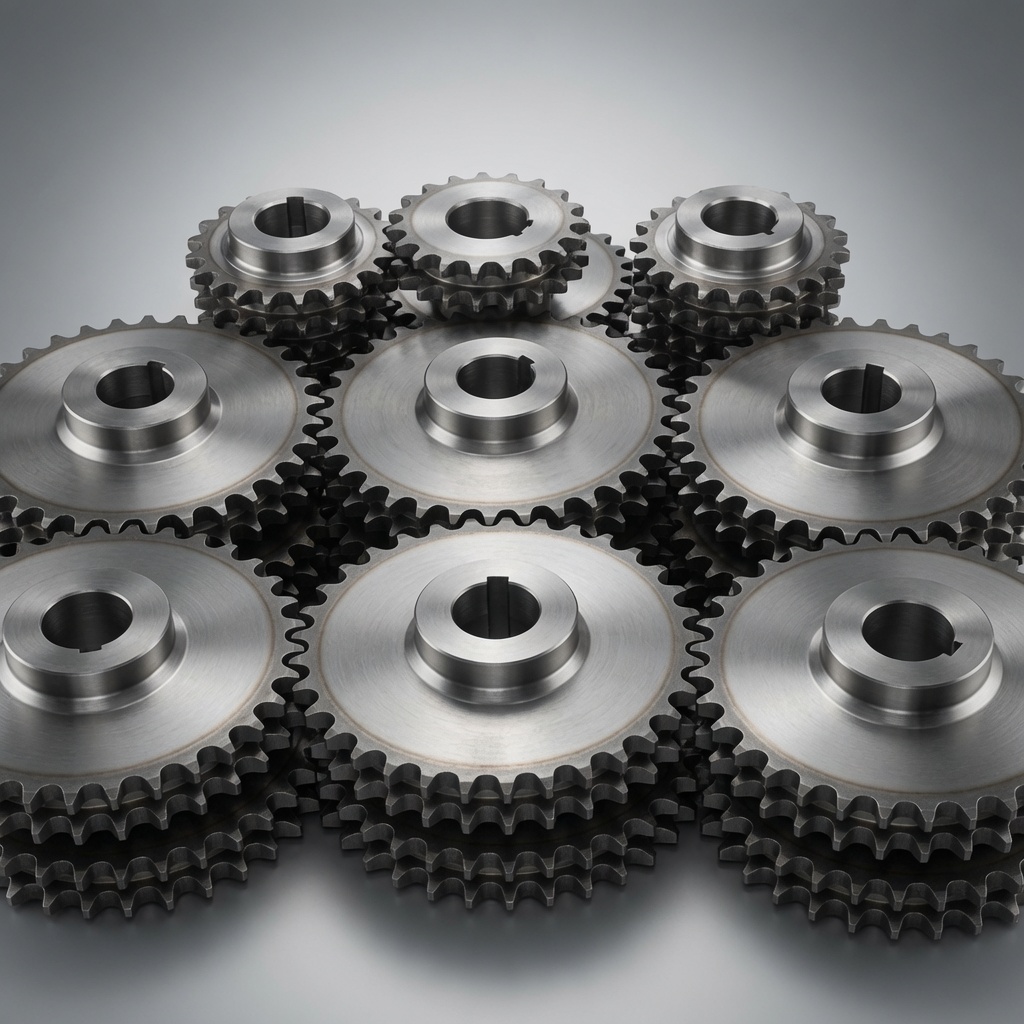
Sprocket pitch is the arc length between adjacent tooth centres on the pitch circle of the sprocket. It must exactly equal the chain pitch for the chain to engage correctly. This is the defining relationship that links every chain to its correct sprocket: ANSI roller chain sprockets are designed so that the distance from one tooth centre to the next, measured along the pitch circle, matches the centre-to-centre distance between adjacent chain rollers.
The Pitch Circle: Where Pitch Is Defined
The pitch circle is an imaginary circle of diameter Dp (pitch diameter) on which the centres of the chain rollers sit as they engage the sprocket. The pitch circle is not directly visible on the sprocket — it lies within the tooth profile, passing through the roller contact points. All chain-length and centre-distance calculations use the pitch circle diameter, not the outside diameter or any other measurable surface.
The pitch circle diameter (Dp) is related to pitch (p) and tooth count (N) by the formula: Dp = p / sin(180° / N). This formula makes it clear that for a fixed pitch, the pitch circle diameter increases with tooth count — a 20-tooth and a 30-tooth sprocket of the same pitch have different diameters but the same tooth-to-tooth spacing on their respective pitch circles.
ANSI Chain Pitch Standards: The Complete Reference
| Chain No. | Pitch (inches) | Pitch (mm) | Roller Dia. (in) | Inner Width (in) | Typical Application |
|---|---|---|---|---|---|
| 25 | 1/4″ | 6.35 mm | 0.130″ | 0.125″ | Light conveyors, instrumentation, food equipment |
| 35 | 3/8″ | 9.525 mm | 0.200″ | 0.188″ | Agricultural feeders, vending, light conveying |
| 40 | 1/2″ | 12.7 mm | 0.312″ | 0.312″ | General industrial, packaging, food processing |
| 50 | 5/8″ | 15.875 mm | 0.400″ | 0.375″ | Medium conveyors, agricultural, bottling lines |
| 60 | 3/4″ | 19.05 mm | 0.469″ | 0.500″ | Heavy conveyors, agriculture, food processing |
| 80 | 1″ | 25.4 mm | 0.625″ | 0.625″ | Heavy industrial, combine main drives, mining |
| 100 | 1-1/4″ | 31.75 mm | 0.750″ | 0.625″ | Main drives, large agricultural, heavy industrial |
BS/DIN Chain Pitch Standards: ISO 606 Reference
| Chain No. | Pitch (mm) | Roller Dia. (mm) | Inner Width (mm) | ANSI Equivalent (pitch only) |
|---|---|---|---|---|
| 06B | 9.525 | 6.35 | 5.72 | No.35 (different roller) |
| 08B | 12.7 | 8.51 | 7.75 | No.40 (different roller) |
| 10B | 15.875 | 10.16 | 9.65 | No.50 (same roller, different width) |
| 12B | 19.05 | 12.07 | 11.68 | No.60 (different roller) |
| 16B | 25.4 | 15.88 | 17.02 | No.80 (same roller, different width) |
Pitch and Speed: How Chain Pitch Determines Drive Speed
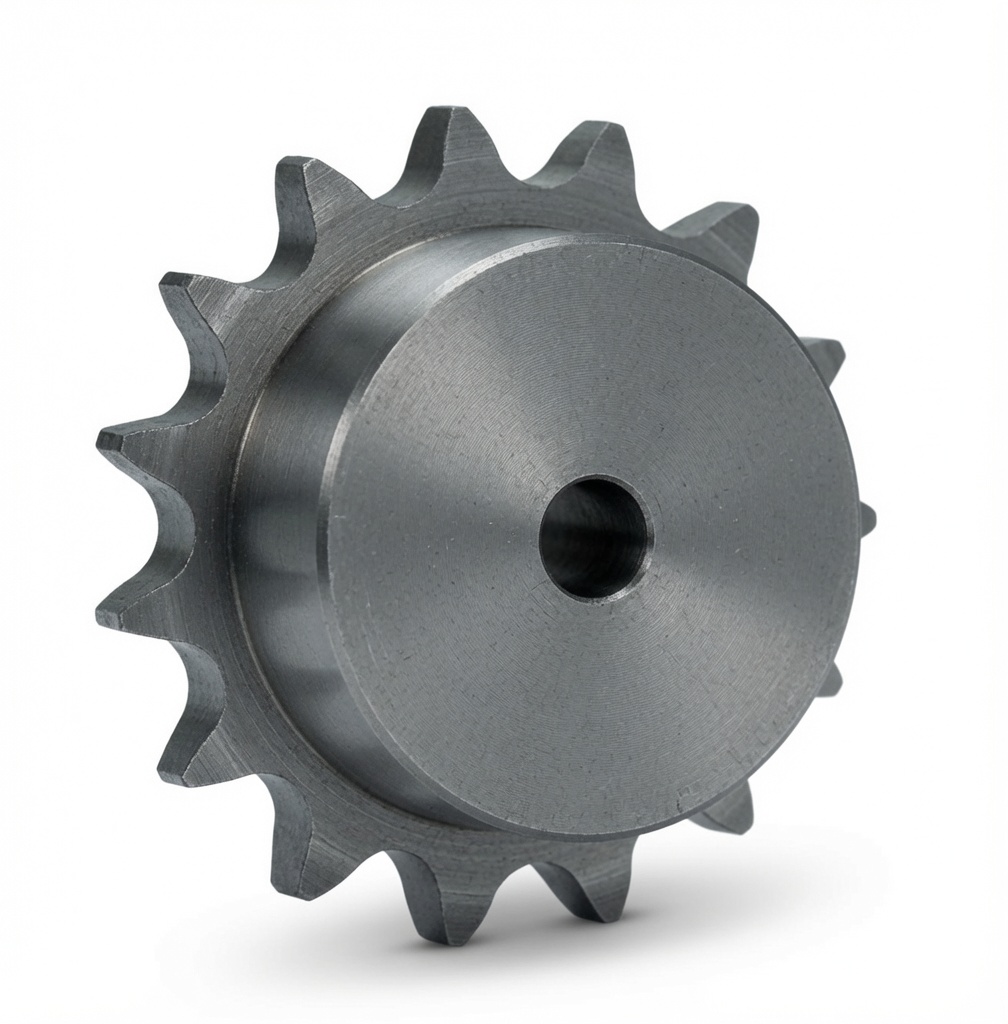
Chain pitch directly determines the relationship between sprocket speed and chain speed. Chain speed (in metres per minute or feet per minute) equals the product of sprocket speed (in RPM), tooth count, and chain pitch:
For a 20-tooth sprocket running at 300 RPM on No.40 (1/2″ pitch) chain: Chain speed = 300 × 20 × 0.5″ = 3,000 inches/min = 250 feet/min = 76.2 metres/min. This relationship explains why changing pitch affects chain speed even when tooth count and RPM remain unchanged — a larger pitch produces faster chain movement at the same sprocket rotation speed.
Choosing the Right Chain Pitch for a New Drive Design
Selecting chain pitch for a new drive involves balancing several competing requirements. Smaller pitches allow smaller sprockets for a given tooth count, reducing rotating mass and chordal action, but have lower load capacity per chain width. Larger pitches carry more load but require larger sprockets and produce more severe chordal action at the same speed. Our stainless steel sprocket range covers pitches from 6.35 mm (No.25 / 06B) through 31.75 mm (No.100), providing selection flexibility across the full industrial range.
Common Pitch-Related Errors and How to Avoid Them
Hangzhou Ever-Power manufactures stainless steel, carbon steel, and custom sprockets for global industrial buyers. Low MOQ, full documentation, fast lead times.
SHENHUA ROAD, HANGZHOU, CHINA | +86-571-88220653