
Cast iron is one of the oldest materials used in industrial sprocket manufacture, and in modern engineering it is also one of the most frequently misapplied. Engineers who have not worked with cast iron sprockets often assume they are simply a cheaper, weaker version of steel — suitable when cost matters and performance can be compromised. The reality is more nuanced: cast iron has genuine performance advantages over steel in specific conditions, and genuine disadvantages in others. Understanding both sides of this material comparison is necessary to avoid both the mistake of using cast iron where steel is essential, and the mistake of reflexively upgrading to steel where cast iron is perfectly adequate and more economical.
Cast Iron Sprockets: Material Properties and What They Mean in Practice
Grey cast iron (GCI) and ductile cast iron (DCI) are the two cast iron grades used for sprockets. Grey cast iron has a graphite microstructure that provides excellent vibration-damping properties and good machinability, but relatively low tensile strength (150–300 MPa) and essentially zero ductility — grey iron is brittle and fractures without yielding under impact. Ductile cast iron (also called nodular or SG iron) has a spheroidal graphite structure that provides better tensile strength (400–600 MPa) and some ductility, making it the preferred cast iron grade for sprockets that must handle moderate shock loading.
Cast iron sprockets are almost always manufactured by sand casting, which allows large, complex shapes to be produced economically for quantities where the tooling cost of forging or machining from solid billet would be prohibitive. The ability to cast large-diameter sprockets with complex hub profiles at relatively low tooling cost is the primary economic justification for cast iron in sprocket manufacture. Heavy duty roller chain sprockets at diameters above 24 inches and weights above 30 kg are often cast iron for this reason.
Steel Sprockets: Structural Advantage Over Cast Iron
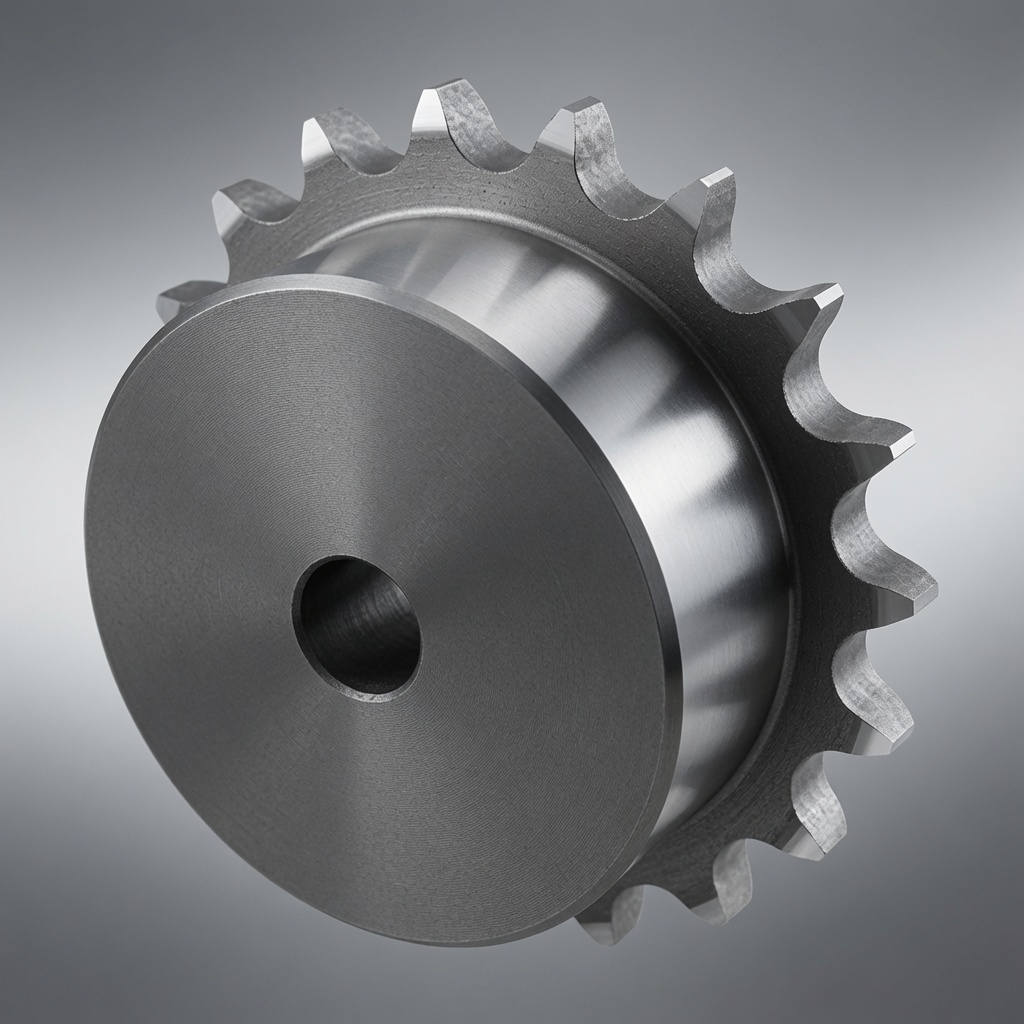
Wrought steel sprockets — whether machined from billet, forged, or hobbed from plate — have a grain structure that is fundamentally superior to cast iron for fatigue and impact applications. The wrought microstructure has no casting porosity, no shrinkage voids, and no graphite inclusions that act as stress concentrators. Drive chain sprockets in C45 steel with HF hardening achieve tooth-face hardness of 40–50 HRC and fatigue strengths that are 3–5 times higher than grey cast iron at equivalent cross-sections.
For sprockets in the standard ANSI and BS/DIN pitch range below about 18 inches outside diameter, steel is almost always used because the machining cost from billet or the forging tooling cost is manageable, and the performance advantage of steel over cast iron is clear. Cast iron is rarely specified for sprockets below No.60 pitch at standard catalogue tooth counts, because the size and weight savings from casting are not significant enough to justify the inferior impact strength at these dimensions.
The Vibration Damping Advantage of Cast Iron
Grey cast iron’s graphite microstructure provides genuinely superior vibration and noise damping compared to steel. The graphite flakes in grey iron act as internal crack propagators for stress waves, dissipating vibrational energy as heat rather than transmitting it through the component. For large, slow-speed sprockets in drives where vibration and noise are concerns — large industrial fans, printing presses, paper mills — this damping characteristic can be a genuine performance advantage over steel.
This damping advantage is most pronounced in grey cast iron; ductile iron provides better strength at the cost of reduced damping. Engineers specifying cast iron specifically for its damping properties should use grey iron grades rather than ductile iron, accepting the lower tensile strength and zero ductility that accompany the superior damping.
Side-by-Side Comparison: Cast Iron vs Steel Sprockets
| Parameter | Grey Cast Iron | Ductile Cast Iron (SG) | C45 Carbon Steel | 304 Stainless Steel |
|---|---|---|---|---|
| Tensile strength | 150–300 MPa | 400–600 MPa | 600–800 MPa (HF-Q) | 515 MPa min |
| Impact resistance | Very low (brittle) | Moderate | High | High |
| Tooth surface hardness | ~200 HB as-cast | ~250 HB as-cast | 40–50 HRC (HF-Q) | Rb 80–90 |
| Vibration damping | Excellent | Good | Poor–moderate | Poor–moderate |
| Machinability | Excellent | Good | Good | Moderate |
| Manufacturing method | Sand casting | Sand casting | Forged/machined | Machined from bar |
| Corrosion resistance | Poor (similar to steel) | Poor | Poor (bare) | Excellent |
| Suitable for large diameters | Yes — economical casting | Yes | Possible; costly at large size | Possible; very costly large |
| Shock load resistance | Avoid | Acceptable with care | Excellent | Good |
| Maximum chain speed | Moderate (low mass) | Moderate | Very high | High |
| Cost at large size | Low | Low–moderate | High | Very high |
Where Cast Iron Sprockets Are the Right Choice
Three conditions favour cast iron over steel for chain and sprocket sets in industrial drives, and all three involve size, economics, and operating environment in combination.
Where Steel Must Be Used Instead of Cast Iron
Making the Right Material Choice: Cast Iron or Steel?
The decision framework for cast iron versus steel in sprocket selection converges on three questions: Is the sprocket large enough (above 18″ OD) for casting economics to apply? Is the load steady and free from significant shock? Is the environment dry and corrosion-free? If all three answers are yes, cast iron (particularly ductile iron for moderate loads) is a reasonable choice. If any answer is no — particularly the shock loading question — steel is the correct specification. Contact our engineering team to discuss OEM sprocket manufacturer capabilities in both materials across your required size range.
Hangzhou Ever-Power manufactures stainless steel, carbon steel, and custom chain sprockets for global industrial buyers. Low MOQ, full documentation, fast lead times from Hangzhou, China.
SHENHUA ROAD, HANGZHOU, CHINA | +86-571-88220653