When an engineer calculates the power requirement for a chain drive and finds that a single-strand (simplex) chain cannot carry the load without exceeding rated capacity, there are two mechanical solutions: step up to a larger pitch chain, or add more strands at the same pitch. The second path leads to duplex (two-strand) and triplex (three-strand) chain drives — and to the multi-strand sprockets that engage them. Understanding when each configuration is the right answer, and what engineering trade-offs each brings, is a practical skill that matters in agricultural machinery, heavy conveyors, and any application where power density and space constraints interact.
Definitions: Simplex, Duplex, and Triplex
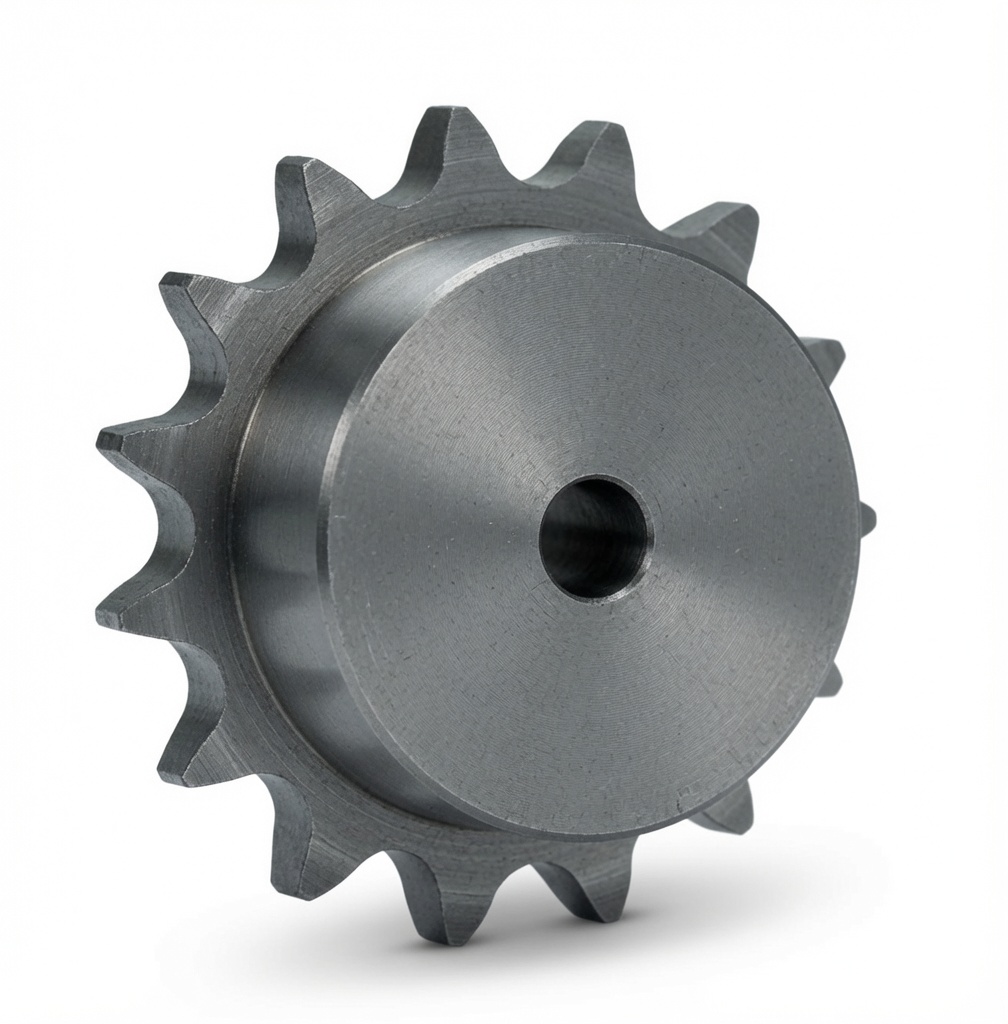
The terms simplex, duplex, and triplex describe the number of parallel chain strands in a chain drive, and correspondingly the number of tooth rows on the sprockets that engage them. A simplex sprocket has one row of teeth and engages a single-strand chain. A duplex sprocket has two parallel tooth rows spaced at the correct inner link width spacing for two chain strands side by side. A triplex sprocket has three parallel rows. All three configurations are available across the full range of ANSI and BS/DIN chain pitches, and ANSI roller chain sprockets in duplex and triplex configurations are produced in the same tooth counts and bore ranges as simplex versions.
| Configuration |
Strands |
Tooth Rows |
Relative Load Capacity |
Common Designations |
| Simplex |
1 |
1 |
1× baseline |
No.40, 08B, No.25B |
| Duplex |
2 |
2 |
1.7× to 1.9× simplex |
No.40-2, 08B-2, #40-2SS |
| Triplex |
3 |
3 |
2.5× to 2.7× simplex |
No.40-3, 08B-3, #40-3SS |
Why not 2.0× for duplex? The load rating of a duplex chain is not exactly twice simplex because the inner and outer strands of a multi-strand chain share a common pin, and manufacturing tolerances in pin straightness and strand spacing mean that load distribution between strands is never perfectly equal. A 5–15% de-rating factor is applied, producing the 1.7×–1.9× effective multiplier.
Why Use Multiple Strands Instead of a Larger Pitch?
When a simplex drive at one chain pitch is insufficient for the power requirement, the engineer faces a fundamental choice: move to the next larger pitch, or go multi-strand at the current pitch. The larger pitch option produces bigger, heavier sprockets and a coarser, heavier chain — but keeps the drive as simple as possible. The multi-strand option keeps sprocket diameters smaller at the cost of adding chain strand complexity. The right choice depends on five factors that interact differently in every application.
Sprocket Diameter Constraint
Moving to a larger pitch at the same tooth count increases sprocket outside diameter proportionally. If the existing sprocket diameter already approaches the maximum allowed by machine frame clearances, moving to duplex at the current pitch is the only way to increase load capacity without redesigning the machine structure.
Chain Speed
Larger pitch chains produce more severe chordal action at the same conveying speed, and have lower maximum recommended speed ratings than finer pitches. If the drive is running near the maximum speed for the current chain pitch, moving to a larger pitch will produce a drive that exceeds the speed rating of the heavier chain. Duplex at current pitch avoids this problem.
Weight and Rotating Inertia
Multi-strand sprockets at a given pitch are wider but not necessarily heavier than a single larger-pitch sprocket providing the same load capacity. In applications where rotating inertia of the drive elements affects machine dynamics — rapid start-stop cycles, precision positioning, high-speed packaging — the multi-strand approach at finer pitch often produces lower rotating inertia than the equivalent single-strand larger-pitch drive.
Inventory and Replacement Parts
If a machine already uses a particular chain pitch throughout its drives — feeding, conveying, auxiliary functions — extending that pitch to multi-strand for the main drive keeps spare parts inventory at one pitch designation. A larger-pitch main drive adds a second chain size to the inventory, complicating procurement and increasing the risk of having the wrong spare on hand during a breakdown.
Space Available for Chain Width
Multi-strand chains and sprockets are wider than simplex at the same pitch. If the drive shaft has limited width between bearings or frame members, the wider sprocket hub may not fit. Conversely, a larger-pitch sprocket at the same tooth count has a larger diameter that may not fit in the available vertical or horizontal clearance. Measure both dimensions before committing to either option.
Load Capacity: How the Numbers Work in Practice
The following worked example shows the load capacity comparison between simplex, duplex, and triplex for No.40 ANSI chain at a representative speed, using published chain breaking loads and a standard service factor.
| Configuration |
Chain |
Break Load |
Working Load (÷6 SF) |
Effective Load with De-Rating |
| Simplex |
No.40 × 1 |
3,125 lbs |
520 lbs |
520 lbs (baseline) |
| Duplex |
No.40 × 2 |
6,250 lbs × 1.75 |
1,822 lbs (÷6 SF) |
~910 lbs (÷2 strands, 90% efficiency) |
| Triplex |
No.40 × 3 |
9,375 lbs × 2.5 |
2,604 lbs (÷6 SF) |
~1,300 lbs (÷3 strands, 83% efficiency) |
| Simplex next pitch |
No.50 × 1 |
4,880 lbs |
813 lbs |
813 lbs (56% more than No.40 simplex) |
This table illustrates why duplex is often the right answer: it nearly doubles load capacity at the same pitch and sprocket diameter, at roughly twice the chain cost — without requiring new sprockets, new chain pitch tooling, or changes to the machine frame. Triplex provides further capacity at diminishing efficiency returns and significant additional chain cost.
Sprocket Width and Hub Considerations for Multi-Strand Drives
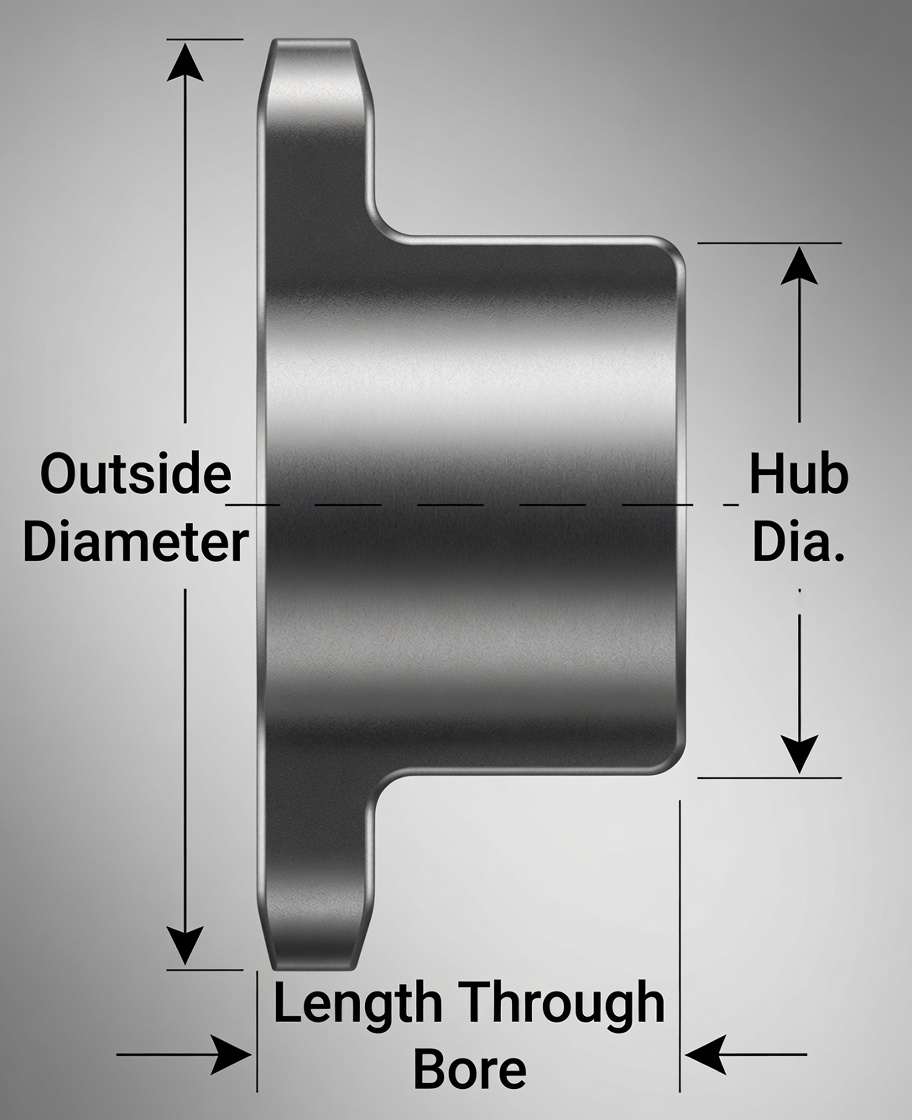
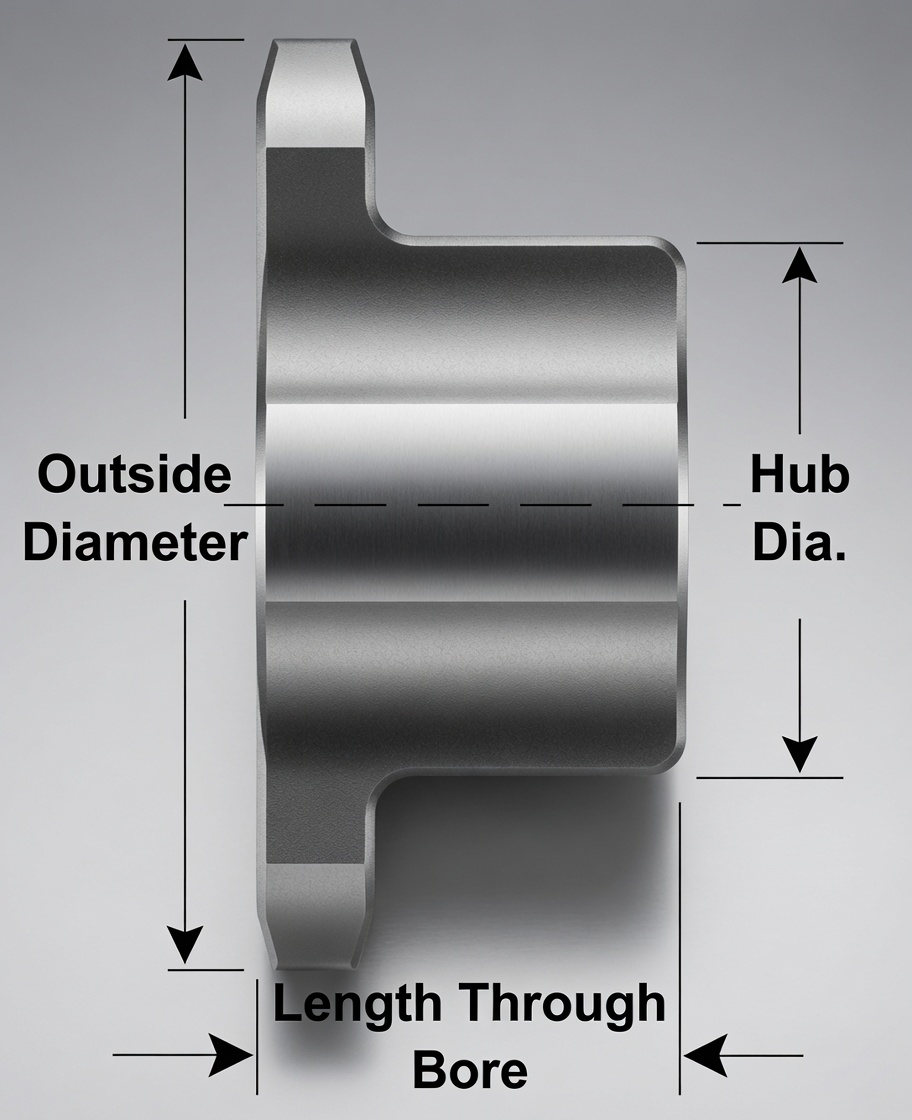
Multi-strand sprockets are machined with multiple tooth rows separated by the chain inner link width plus the chain strand spacing. The total sprocket width (the face width that the chain contacts) equals the sum of the individual strand widths plus the inter-strand spacers. This added width affects hub design and shaft loading in ways that matter for conveyor chain sprockets in heavy multi-strand configurations.
A wider sprocket hub at the same shaft diameter produces more bending moment at the shaft bearings from the chain tension load, and this increased overhung load must be included in the shaft and bearing selection calculations for multi-strand drives. The rule of thumb is to keep the chain load application point as close as possible to the nearest bearing — which for wide multi-strand sprockets means minimising the distance between the sprocket centre and the bearing face.
When to Recommend Each Configuration
Simplex
Single-strand — standard choice for all drives within rated capacity
Use when a single-strand chain at the selected pitch handles the required load within the rated capacity at the operating speed. This is the default configuration for the vast majority of industrial chain drives.
Duplex
Two-strand — preferred upgrade path when simplex capacity is exceeded
Use when simplex rated capacity is insufficient and the application has either sprocket diameter constraints that prevent moving to a larger pitch, or the chain speed is near the maximum for the next-larger pitch. Duplex is also preferred when inventory standardisation on a single chain pitch is important.
Triplex
Three-strand — reserve for the highest-load applications where duplex is still insufficient
Use when duplex capacity is still insufficient and a larger pitch chain would exceed speed limits or space constraints. Triplex chains and sprockets are more expensive and harder to source than simplex or duplex, so they should be specified only when genuinely necessary. Maintenance cost and downtime on a triplex drive are both higher than equivalent simplex or duplex, due to the greater complexity of re-chaining.
Multi-Strand vs. Upgrading Chain Pitch: A Practical Decision Summary
| Factor |
Choose Multi-Strand Same Pitch |
Choose Larger Single Pitch |
| Sprocket diameter |
Constrained by frame clearance |
Space available for larger diameter |
| Chain speed |
Near upper limit for current pitch |
Within upper limit for next pitch |
| Inventory standardisation |
Same pitch throughout machine |
Dedicated main-drive pitch acceptable |
| Available hub width |
Wide hub fits on shaft |
Hub width constrained |
| Cost |
Lower total cost (reuse sprocket size tooling) |
Higher if new tooling needed; otherwise similar |
| Maintenance simplicity |
More complex re-chaining |
Simpler single-strand service |
Need Industrial Sprockets? Get a Factory-Direct Quote
Hangzhou Ever-Power manufactures stainless steel, carbon steel, and custom chain sprockets for global industrial buyers. Low MOQ, full documentation, fast lead times.
SHENHUA ROAD, HANGZHOU, CHINA | +86-571-88220653
Frequently Asked Questions
1. Can I use a duplex sprocket with a simplex chain?+
No. A duplex sprocket has two tooth rows separated by an inner strand spacer. A simplex chain engages only one tooth row and will ride against the spacer on one side and the outer plate on the other, producing misalignment and rapid wear. Always match the number of sprocket tooth rows to the number of chain strands.
2. What is the de-rating factor for multi-strand chains?+
Standard industry practice applies a de-rating to multi-strand chain load capacity to account for unequal load sharing between strands: duplex = 1.7× (not 2×) and triplex = 2.5× (not 3×) the simplex rated load. Some standards specify slightly different factors — always use the value in the specific chain manufacturer’s catalogue for the chain grade being used.
3. Are multi-strand sprockets more expensive than simplex?+
Yes, by approximately 30–60% for duplex and 60–100% for triplex, compared to simplex sprockets of the same pitch and tooth count. The additional cost reflects the wider face machining, additional tooth rows, and more complex hobbing setup. Multi-strand chains also cost proportionally more per linear foot.
4. Can I run duplex chain on a triplex sprocket in an emergency?+
Duplex chain running on a triplex sprocket will engage only two of the three tooth rows, leaving the outer row without chain contact. This is mechanically acceptable as a very short-term emergency measure — the chain will function on the two engaged rows — but the misloaded chain will wear rapidly and the outer tooth row will remain unworn while the other two wear. This is not a long-term solution.
5. Is the pitch of multi-strand chain the same as simplex chain?+
Yes. Duplex and triplex chain have exactly the same pitch as the equivalent simplex chain — the chains differ only in width (the number of parallel strands), not in pitch. A No.40 duplex chain has the same 1/2″ pitch as a No.40 simplex chain, and both run on sprockets with the same pitch diameter for a given tooth count.
Hangzhou Ever-Power Sprocket Chain Co., Ltd.
