Few mechanical components are as quietly essential as the sprocket. Across hundreds of industries — from grain harvesting to pharmaceutical packaging, from bicycle drivetrains to massive mining conveyors — the sprocket is the device that converts rotary shaft motion into controlled linear movement through a chain. Yet many engineers and maintenance technicians who work with chain drives every day would struggle to articulate exactly what a sprocket is, how it differs from a gear, and why those differences matter for drive design. This article answers those questions thoroughly.
What Is a Sprocket? A Precise Definition
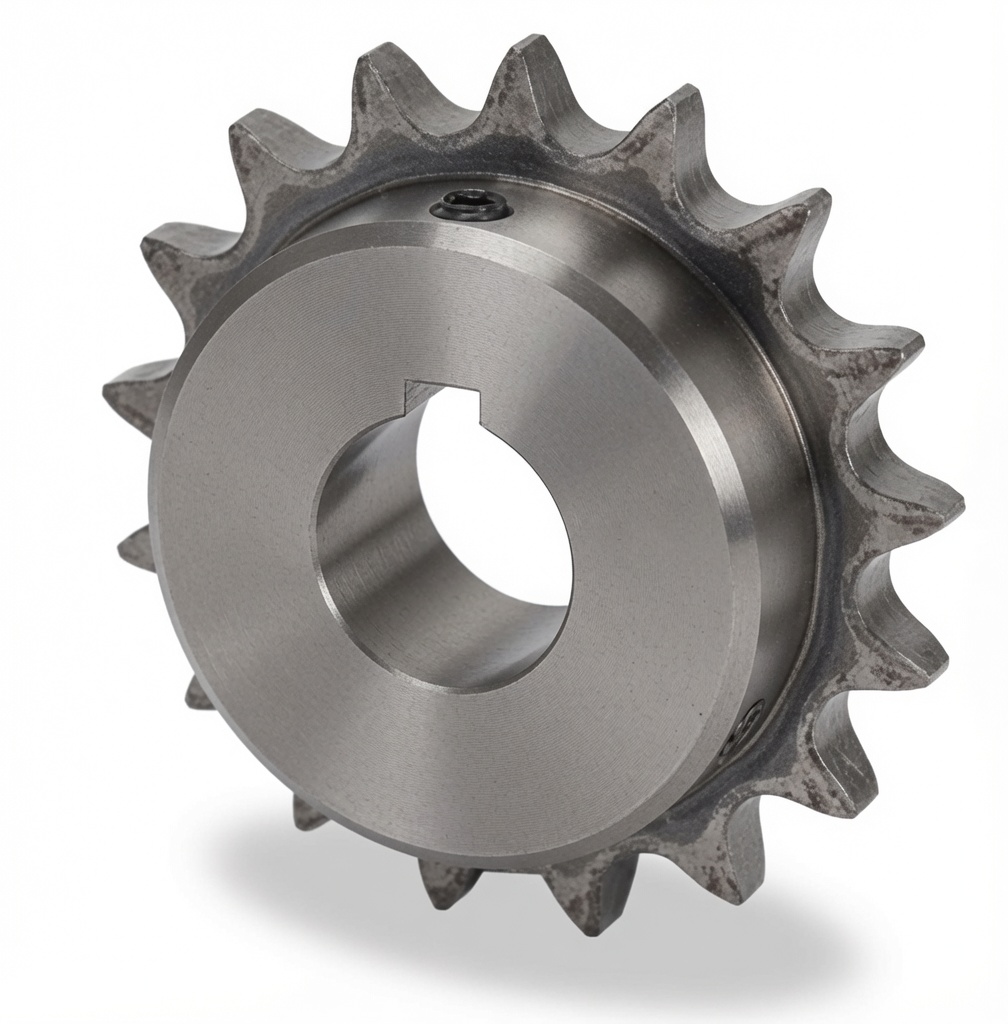
A sprocket is a wheel with evenly spaced, profiled teeth around its circumference, designed to mesh with the links of a roller chain, timing belt, or similar positively engaging drive element. Unlike a pulley — which transmits force through friction with a belt — a sprocket engages its drive element mechanically at each tooth, making the connection positive and slip-free. The teeth are not simply projections; their geometry is precisely calculated to match the roller diameter and pitch of the specific chain they are designed to drive.
The word “sprocket” traces back to the sixteenth century in English, originally describing tooth-like projections on a wheel. In modern engineering usage, the term exclusively refers to toothed wheels used with chains, as opposed to gears (which mesh directly with other gears) or pulleys (which engage belts through friction or synchronisation). This distinction carries practical weight: the design rules, tolerance requirements, and failure mechanisms for sprockets differ meaningfully from those governing gears.
The Primary Functions of a Sprocket in a Chain Drive
A sprocket serves three distinct mechanical functions within a chain drive system, and understanding each one helps clarify both its design requirements and its failure modes.
Function 1: Power Transmission
The sprocket transfers torque from the drive shaft to the chain with virtually no slip, unlike belt-and-pulley systems. Each tooth engagement delivers a discrete increment of force to the chain, making the sprocket-chain combination one of the most mechanically efficient power transmission methods available for shaft-to-shaft or shaft-to-linear applications.
Function 2: Speed and Torque Conversion
By selecting sprockets of different tooth counts on the driving and driven shafts, a chain drive functions as a fixed-ratio mechanical advantage device. A 10-tooth driver paired with a 40-tooth driven sprocket produces a 4:1 speed reduction with corresponding torque multiplication — exactly the same relationship as a gear pair, but with chain instead of direct tooth contact.
Function 3: Direction and Layout Flexibility
Unlike direct gear drives, a sprocket-chain system can connect shafts that are separated by significant distances, offset horizontally, or arranged in layouts impossible for gear pairs. This flexibility — the ability to drive across metres of distance, around corners with idler sprockets, and in configurations requiring multiple driven axes — is the core reason chain drives appear in machinery that gear drives cannot practically serve.
How a Sprocket Differs from a Gear: Four Key Distinctions
The sprocket is frequently confused with the gear, and superficially the resemblance is real — both are toothed wheels used in power transmission, both appear in engineering catalogues as precision components, and both convert rotational input into useful mechanical output. But the differences between them are fundamental, not cosmetic. Understanding these distinctions is essential for engineers selecting between chain drives and gear drives for a given application. Our industrial sprockets are designed around these distinctions from the ground up.
| Characteristic |
Sprocket |
Gear |
| Engagement method |
Meshes with a chain (indirect contact) |
Meshes directly with another gear tooth |
| Contact type |
Positive, through chain roller |
Positive, tooth-to-tooth direct |
| Shaft separation |
Large distances easily accommodated |
Limited by gear diameter; complex for long centres |
| Speed ratio change |
Simple: change sprocket tooth count |
Requires replacing both mating gears |
| Lubrication |
Chain lubricant; open or enclosed |
Enclosed gear oil typically required |
| Noise at speed |
Moderate (chordal action effect) |
Low with helical teeth; higher with spur teeth |
| Load capacity |
High, limited by chain rating |
Very high, limited by tooth bending and contact stress |
| Axis direction |
Parallel only (standard chain) |
Parallel, crossed, or skewed (bevel/worm) |
Sprocket Anatomy: Key Components and Terms
Reading a sprocket drawing or catalogue entry without understanding the standard terminology leads to ordering errors and installation problems. The following terms appear on every engineering drawing and specification for a chain sprocket.
P
Pitch — The Fundamental Dimension
Pitch is the distance between adjacent roller centres on the chain, and the corresponding tooth-to-tooth distance on the sprocket. It is the single most important matching dimension between chain and sprocket. ANSI chains use inch-based pitches (1/4″, 3/8″, 1/2″, etc.); BS/DIN chains use metric-derived pitches (9.525 mm, 12.7 mm, etc.).
D
Pitch Diameter
The diameter of the imaginary circle that passes through the centres of the chain rollers as they engage the sprocket. This is the dimension used for all speed-ratio and chain-length calculations. It is not directly measurable on the finished sprocket but is calculated from pitch and tooth count.
Do
Outside Diameter
The diameter measured at the tips of the teeth. This dimension determines the minimum clearance the sprocket needs in the machine frame and is directly measurable with callipers.
N
Tooth Count
The number of teeth, which determines speed ratio when paired with a sprocket of different tooth count. Tooth count also influences chordal action (speed variation), with higher tooth counts producing smoother chain engagement.
B
Bore Diameter
The diameter of the central hole through which the shaft passes. The bore must match the shaft diameter with appropriate tolerance (typically H7 for press or transition fit).
L
Hub Length (Hub Projection)
The axial length of the hub extending beyond the sprocket face. Longer hubs provide greater shaft engagement and support for set-screws or keyways. The distinction between Type A (no hub), Type B (single hub), and Type C (double hub) sprockets refers to hub configuration.
The Role of Tooth Profile in Sprocket Performance
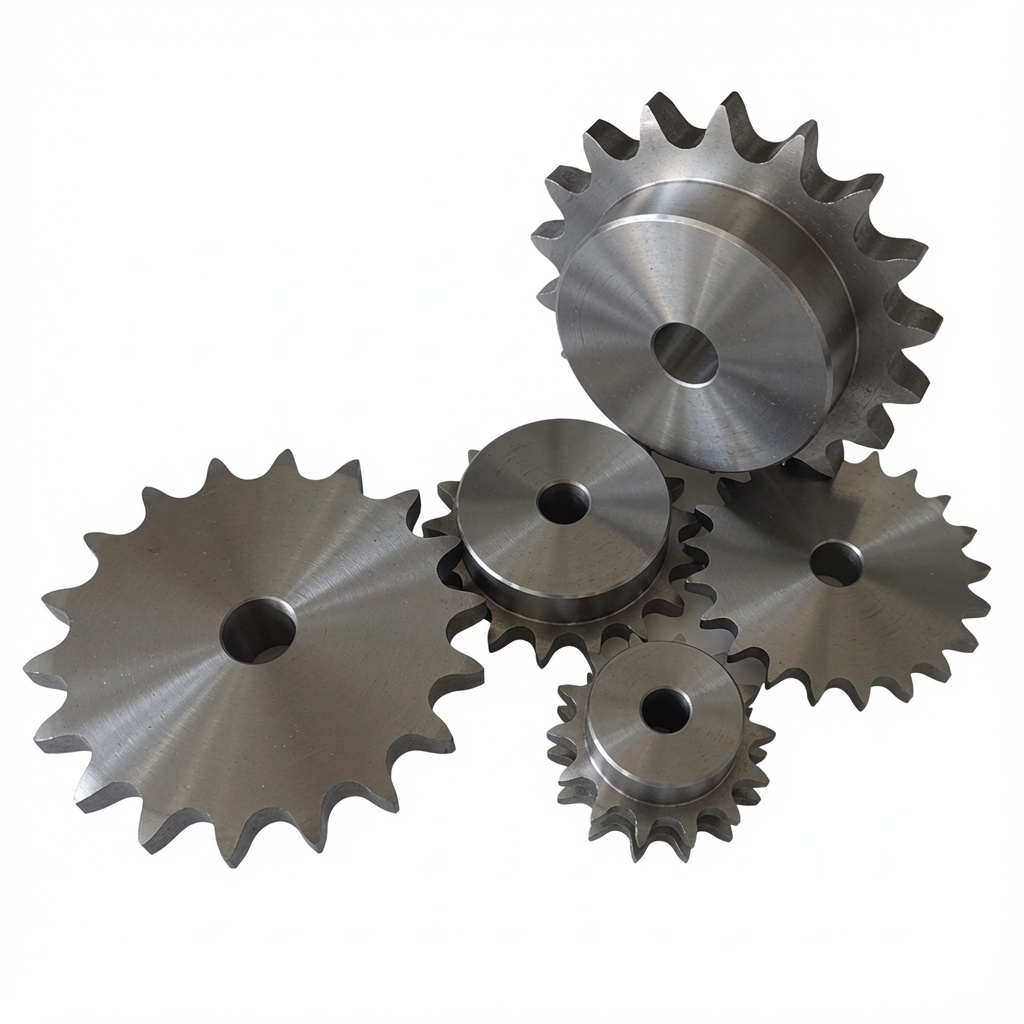
The shape of each tooth — the seating curve at the root, the approach arc on the flanks, and the tip relief at the tooth crown — is not arbitrary. These three geometric elements are precisely defined by ANSI B29.1 (for American standard chains) or ISO 606 (for British/DIN standard chains) based on the specific roller diameter of the chain the sprocket is designed to drive. The seating curve radius matches the roller radius to distribute contact stress across the widest possible area. The approach arc guides the roller smoothly onto the seating curve without impact. The tip relief allows the roller to disengage without jamming.
When a sprocket is manufactured with incorrect tooth profile — either from worn tooling, incorrect hobbing programme setup, or deliberate substitution of an ANSI sprocket for a BS/DIN requirement (or vice versa) — the roller seats at the wrong position on the tooth. This produces higher contact stress, faster tooth wear, chain noise, and, in severe cases, roller fatigue failure. Profile accuracy is the single most consequential dimension in sprocket manufacturing, yet it is also the dimension that buyers most often neglect to verify because it cannot be checked with simple hand tools.
Sprocket Materials: Matching Material to Application
The material from which a sprocket is made determines its corrosion resistance, tooth-surface hardness, maximum load capacity, and suitability for the operating environment. The three most common material categories for chain drive sprockets in industrial service are listed below, along with their primary distinguishing characteristics.
Carbon Steel (C45)
The industry standard for most industrial applications. C45 medium-carbon steel can be induction-hardened to 40–50 HRC on the tooth flanks, providing excellent wear resistance under high cyclic loads. Suitable for dry or lubricated indoor drives where corrosion is not a primary concern. Most agricultural, construction, and general industrial sprockets are C45.
304 Stainless Steel
The specification of choice for food processing, pharmaceutical, marine, and wash-down environments. 304 SS provides excellent corrosion resistance at the cost of lower tooth-surface hardness compared to hardened C45. Passivation after machining restores the protective chromium-oxide surface layer removed during cutting.
Cast Iron / A3 Mild Steel
Used for large-diameter, slow-speed sprockets where the additional machining cost of C45 or stainless steel is not justified by the application requirements. Cast iron provides good damping characteristics but is brittle under impact loading and unsuitable for high-speed drives or shock-load applications.
Where Sprockets Are Used: A Cross-Industry Overview
The sprocket-chain combination appears in a wider range of industries and machine types than most people realise. ANSI roller chain sprockets dominate North American and export markets, while BS/DIN sprockets are the standard for European-specification machinery. The following summary covers the primary industrial sectors.
Food & Beverage Processing
Conveyor drives, filling machines, pasteurisers, and bottling lines. Stainless steel sprockets are mandatory in most food-contact zones. Regular CIP wash-down makes corrosion resistance the primary selection criterion.
Agricultural Machinery
Combine harvesters, seeders, balers, and tillage equipment use chain drives for their ability to transmit power over long distances between moving parts. C45 hardened sprockets handle the abrasive grain-and-chaff environment of harvesting applications.
Mining & Construction Equipment
Conveyor head-shaft drives, feeder drives, and screen drives. Heavy-duty sprockets at No.80 and No.100 chain pitch are common. Sprockets must handle shock loading, abrasive contamination, and outdoor exposure simultaneously.
Industrial Conveyors
Pallet conveyors, overhead trolley systems, and sortation equipment. Double-pitch chain sprockets are widely used in overhead conveying for their low noise and reduced rotating mass compared to standard-pitch equivalents.
Pharmaceutical & Cleanroom
Tablet presses, packaging machines, and laboratory automation equipment. Stainless steel with ASTM A967 passivation is required. Chain and sprocket selection must prioritise zero-contamination risk over cost.
Sourcing Industrial Sprockets: What to Verify Before Ordering
Selecting and sourcing the right sprocket requires confirming five specifications before placing an order: chain standard (ANSI or BS/DIN), chain pitch and designation (e.g. No.40 or 08B), tooth count, bore diameter (with keyway dimensions if applicable), and material grade. Our stainless steel sprockets cover the full ANSI and BS/DIN range in 304 and 316L stainless, with custom bore, keyway, and taper-lock options available factory-direct from Hangzhou with short lead times.
Quick Selection Checklist: (1) Chain designation and pitch (2) Tooth count for required speed ratio (3) Bore diameter and keyway dimensions (4) Material grade for the operating environment (5) Hub type (A, B, or C) for your shaft arrangement
Need Industrial Sprockets? Get a Factory-Direct Quote
Hangzhou Ever-Power manufactures stainless steel, carbon steel, and custom sprockets for global industrial buyers. Low MOQ, full documentation, fast lead times.
SHENHUA ROAD, HANGZHOU, CHINA | +86-571-88220653
Frequently Asked Questions
1. Can a sprocket be used with a V-belt or flat belt?+
No. Sprockets are designed exclusively for positive-engagement drives — roller chains, timing belts, or similar toothed elements. V-belts and flat belts require smooth-surfaced pulleys or sheaves, not toothed sprockets. Using a sprocket with a V-belt would destroy both components immediately.
2. What is the minimum number of teeth a sprocket should have?+
The practical minimum is generally 17 teeth for smoothly running drives. Sprockets with fewer than 17 teeth produce increasingly severe chordal action — speed variation within each tooth engagement cycle — which causes vibration, noise, and accelerated chain wear. Sprockets as small as 9 or 10 teeth are produced for slow-speed applications where chordal action is acceptable, but they should be avoided in precision or high-speed drives.
3. Does it matter which sprocket is the drive sprocket and which is the driven sprocket?+
Mechanically, either sprocket can be on the drive shaft. The drive (smaller) sprocket typically experiences higher tooth loads because it has fewer teeth engaged simultaneously, so it often wears faster. For this reason, when the two sprockets differ significantly in tooth count, the smaller one should be inspected and replaced more frequently.
4. Can I replace just the sprocket without replacing the chain?+
Replacing a sprocket on a worn chain almost always produces premature failure of the new sprocket. A worn chain has elongated pitch — the distance between rollers is greater than new — and the worn rollers do not seat correctly in a new sprocket’s tooth profile. The standard recommendation is to replace chain and sprockets together when either shows significant wear.
5. What is the difference between a sprocket and a chain wheel?+
“Chain wheel” and “sprocket wheel” are informal alternative names for a sprocket. In some European languages and older English technical literature, “chain wheel” or “sprocket wheel” are used interchangeably with the more common “sprocket.” There is no technical distinction between the three terms; they all refer to the same component.
Hangzhou Ever-Power Sprocket Chain Co., Ltd.
