
Among the less frequently discussed principles in chain drive design, the hunting tooth concept stands out for the practical impact it has on drive longevity with minimal added cost. A hunting tooth arrangement requires no special manufacturing, no additional components, and no change to installation procedure — yet it can extend sprocket and chain service life by a factor of two or more in the same operating environment. Understanding why requires a brief look at how wear actually develops in a chain drive, and what happens when the same chain link always meets the same sprocket tooth.
The Wear Problem: Localised Contact in Chain Drives
In a chain drive with an even number of chain links and an even number of teeth on the drive sprocket, a geometric phenomenon occurs that most engineers have never consciously considered: every revolution of the sprocket brings the same chain link into contact with the same sprocket tooth. The pairing is fixed. If chain link #3 seats in tooth pocket #7 on the first revolution, it will seat in tooth pocket #7 on every subsequent revolution — indefinitely — unless the tooth count or link count relationship breaks this pairing.
The consequence is that wear accumulates at exactly the same contact points on both the chain rollers and the sprocket tooth seats. A single roller that is slightly harder than its neighbours will impose its hardness on a single tooth seat, generation after generation of contact. A single tooth pocket with a slightly rough surface finish will gradually wear its permanently paired roller faster than the surrounding rollers wear. This non-uniform wear development accelerates the degradation of both chain and sprocket beyond what random-pairing wear would produce.
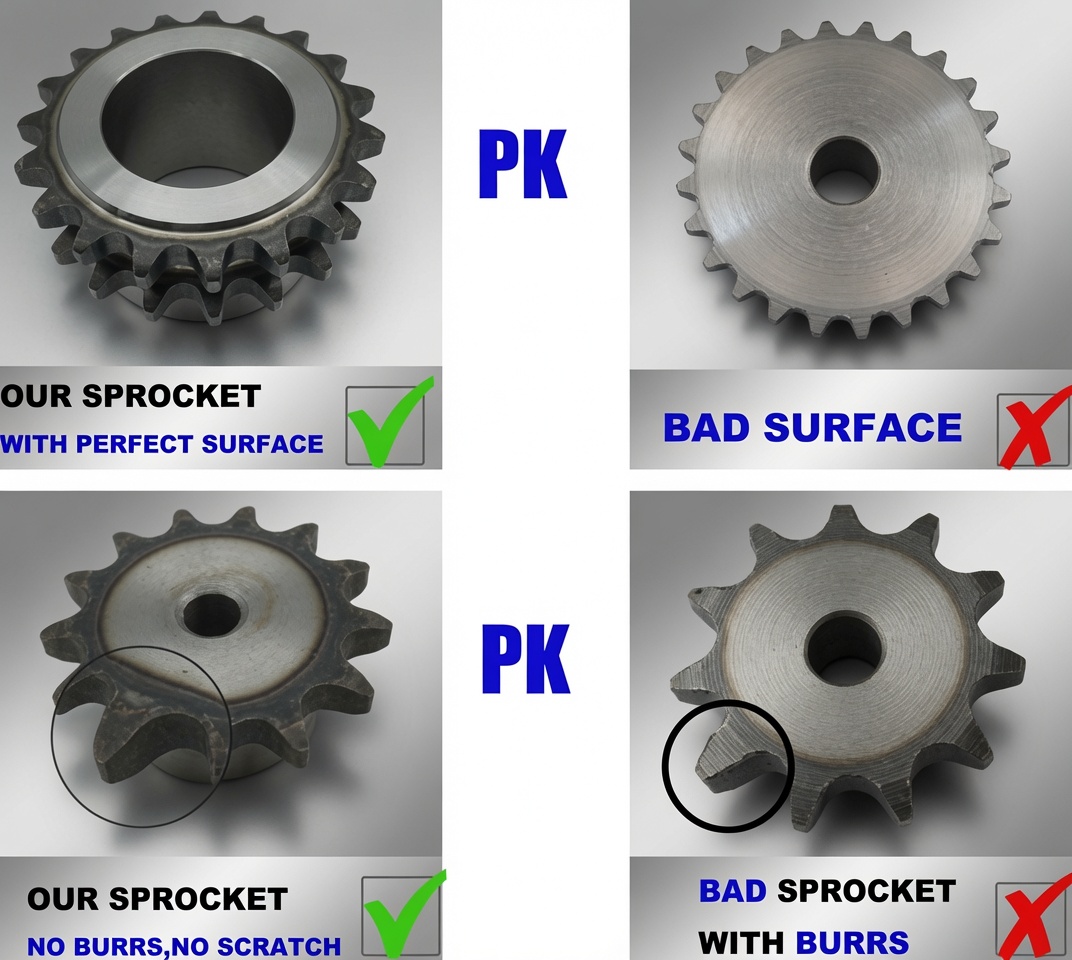
What Is a Hunting Tooth? The Defining Principle
A hunting tooth arrangement, also called tooth hunting or a hunting tooth ratio, is achieved when the greatest common divisor (GCD) of the chain link count and the sprocket tooth count is 1 — meaning the two numbers share no common factors other than 1. When this condition is satisfied, each chain link engages a different sprocket tooth on each successive revolution of the sprocket. No link ever meets the same tooth twice in sequence. Over multiple revolutions, every link contacts every tooth, distributing wear evenly across all contact points on both chain and sprocket.
The simplest way to achieve a hunting tooth relationship is to use an odd number of teeth on the sprocket paired with an even number of links in the chain (the most common case, since standard roller chains are assembled in even-link-count lengths). An odd tooth count ensures that GCD(odd, even) = 1 for any practical chain length, producing the hunting tooth condition automatically.
Why Hunting Tooth Matters: The Wear Distribution Effect
The practical significance of even wear distribution becomes clear when you consider how industrial sprockets fail in real service. Sprocket wear is not uniform in a fixed-pairing drive: the small number of tooth pockets that serve as “dedicated contacts” for their paired chain rollers develop wear grooves faster than the remaining teeth, which are less frequently or less repeatably contacted. Once a wear groove forms, it changes the geometry of roller seating, which accelerates further wear at that point while the less-worn teeth maintain their original profile. This progressive non-uniformity is why a sprocket with localised wear fails prematurely even though most of its tooth surfaces are still within serviceable condition.
In a hunting tooth drive, no such localised progression can develop. Every tooth sees statistically equal contact frequency from the chain rollers, and every roller visits every tooth with equal frequency. The result is that when the drive eventually reaches the wear limit, all teeth are worn to approximately the same depth rather than a few teeth being heavily grooved while most remain serviceable. This flat wear profile means the sprocket and chain remain in usable dimensional relationship for significantly longer than a fixed-pairing drive would allow.
How to Implement Hunting Tooth in a New Drive Design
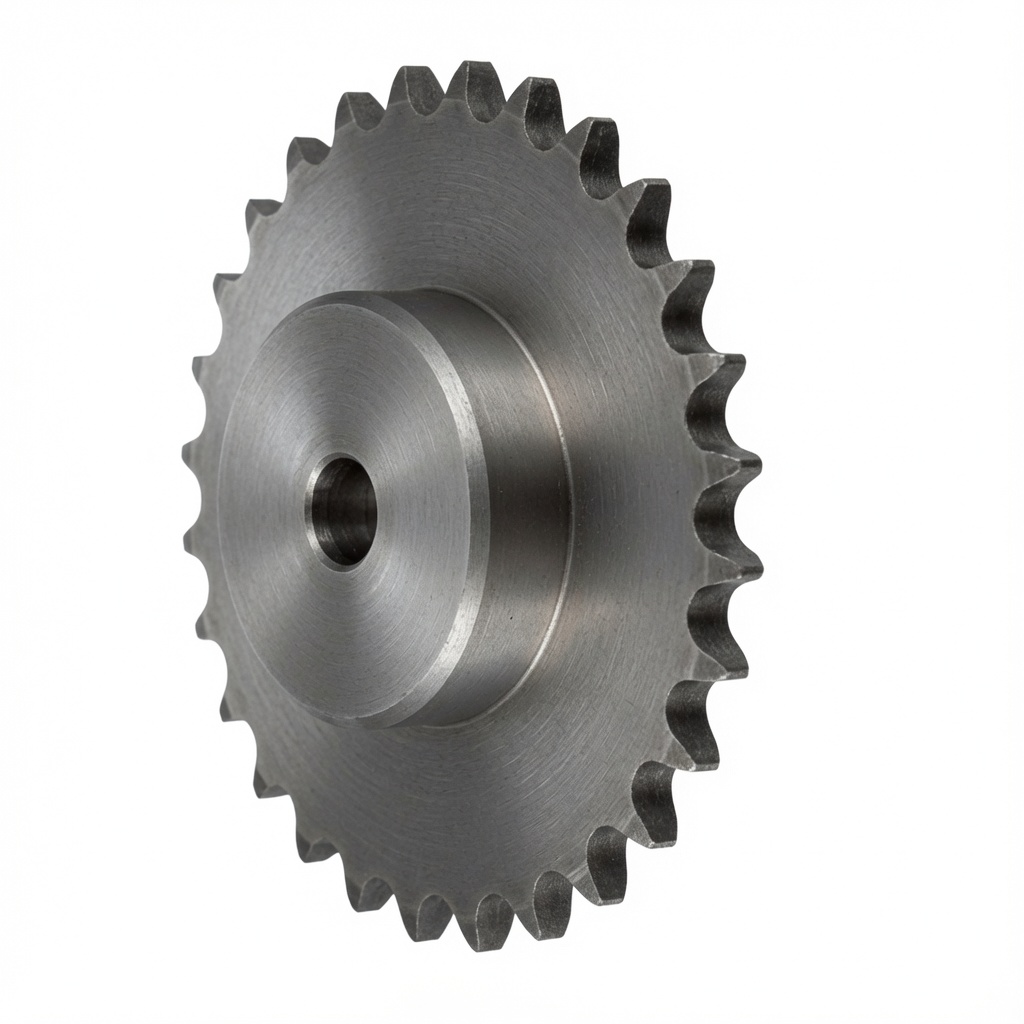
Hunting Tooth vs. Even Tooth Count: A Practical Comparison
| Parameter | Even Tooth Count (Non-Hunting) | Odd Tooth Count (Hunting Tooth) |
|---|---|---|
| Roller-to-tooth pairing | Fixed: same roller meets same tooth each revolution | Rotating: each roller visits every tooth in sequence |
| Wear distribution | Localised at fixed contact pairs | Even across all teeth and rollers |
| Early failure mode | Localised tooth groove wear | Uniform wear to limit across all teeth |
| Typical life improvement | Baseline | 1.5× to 2× in controlled comparisons |
| Cost to implement | — | Zero: tooth count selection only |
| Speed ratio impact | Exact ratio maintained | Minor ratio adjustment may be needed |
| Chain replacement timing | When worn teeth or rollers show grooving | When general wear limit is reached uniformly |
When Hunting Tooth Is Particularly Valuable
The hunting tooth principle applies to all chain drives, but its benefit is most pronounced in specific operating conditions. Heavy duty roller chain sprockets in applications with any of the following characteristics benefit most significantly from a hunting tooth tooth count selection.
The Relationship Between Hunting Tooth and Chain Length Selection
Standard roller chains are manufactured and sold in even-link-count lengths because standard connecting links join two chain ends at a full link interval, and half-links (offset links) that would permit odd-link-count assembly are weaker than full connecting links. For most drives, the even-link-count chain is the natural choice, and simply selecting an odd tooth count for the drive sprocket achieves the hunting tooth condition.
The only complication arises when an even tooth count on the sprocket — perhaps forced by a specific speed ratio requirement — is combined with an even chain link count, producing a fixed pairing with GCD of 2 or higher. In this situation, either the sprocket tooth count should be adjusted (by one tooth, which changes the speed ratio by a small percentage) or a half-link should be inserted to make the chain link count odd. The drive designer must weigh the slight speed ratio deviation of the one-tooth adjustment against the structural penalty of the half-link insertion and choose accordingly.
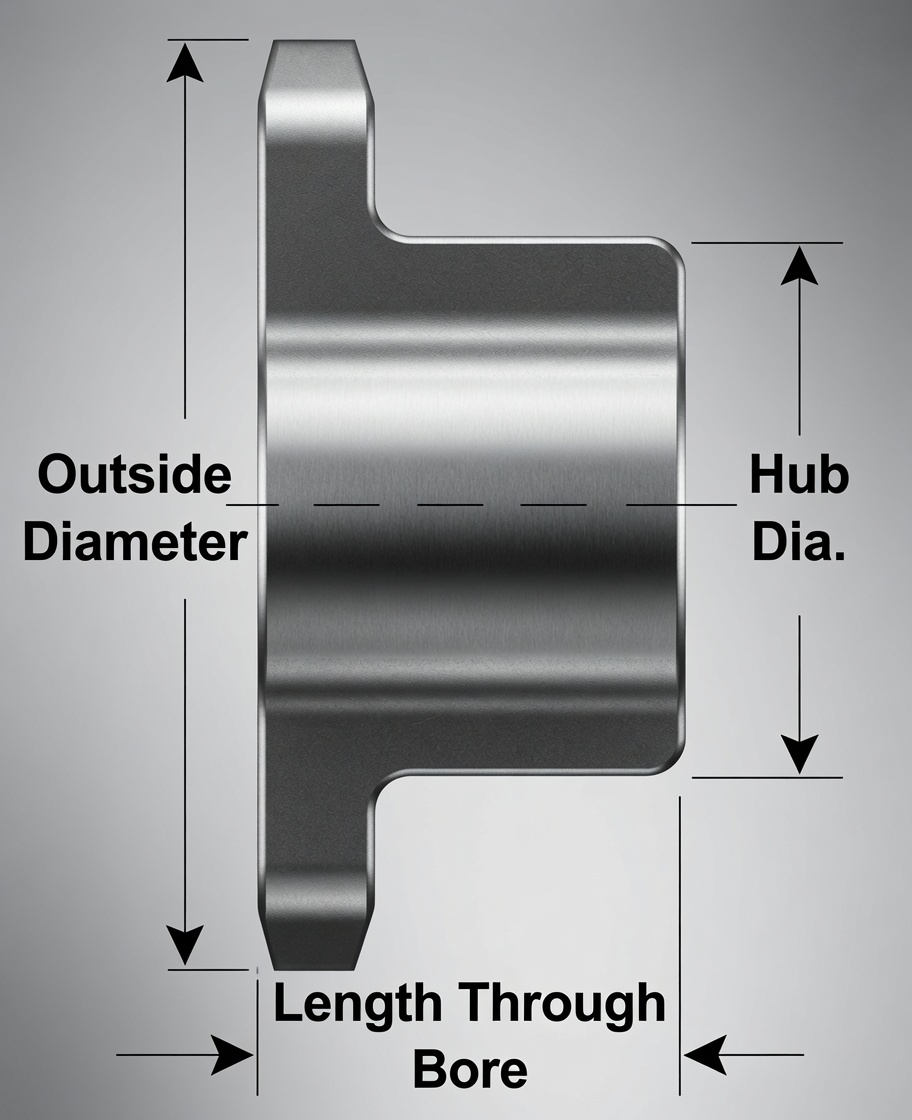
Hunting Tooth in the Context of Complete Drive Maintenance
The hunting tooth principle is one element of a broader chain drive maintenance philosophy that includes correct initial tension, adequate lubrication, periodic tension adjustment as the chain stretches with wear, and timely replacement of both chain and drive sprockets before wear becomes severe enough to damage new replacement components. A hunting tooth drive that is otherwise poorly maintained — under-lubricated, over-tensioned, or allowed to run with excessive chain elongation — will not realise the full service-life benefit that even wear distribution provides.
The most common mistake in chain drive maintenance is replacing only the chain when the sprocket is worn, or replacing only the sprocket when the chain is worn. A worn chain run on a new sprocket transfers its elongated pitch into wear at the new tooth seats within the first few hours of operation. Conversely, a new chain on a worn sprocket never seats correctly in the tooth pockets. In a hunting tooth drive, this issue is actually more visible because wear is uniform across all teeth — the sprocket shows consistent wear depth across its full circumference, making the end-of-life condition easier to judge and the replacement timing more straightforward to specify.
Hangzhou Ever-Power manufactures stainless steel, carbon steel, and custom sprockets for global industrial buyers. Low MOQ, full documentation, fast lead times.
SHENHUA ROAD, HANGZHOU, CHINA | +86-571-88220653