
When browsing a sprocket catalogue or placing an order with a manufacturer, engineers regularly encounter the designations Type A, Type B, and Type C. These letters describe the hub configuration of the sprocket — specifically, whether the sprocket has a protruding boss (hub) on one or both sides, or no hub at all. The hub type affects shaft engagement length, sprocket-to-adjacent-component clearance, and the mounting options available for a given sprocket. Selecting the wrong hub type does not change the drive ratio or chain compatibility, but it can create installation interference problems or insufficient shaft support that the correct hub type would avoid. This article explains each type precisely and provides the guidance needed to select the right hub configuration for common installation scenarios.
Type A Sprocket: Flat or Disc-Type Configuration
A Type A sprocket has no protruding hub on either side of the sprocket face. The sprocket is essentially a flat disc with teeth on the periphery, a central bore, and typically no provision for a set screw or keyway in the hub body. Type A sprockets are sometimes called “plate sprockets” for this reason. The bore diameter goes directly through the thin disc body of the sprocket, providing minimal shaft contact length — typically only the width of the sprocket face itself. Our double pitch conveyor sprockets in Type A configuration are commonly used for exactly these applications.
Because Type A sprockets have no hub projection, they are not used for direct shaft mounting in torque-transmitting applications in most cases. Their primary application is as idler sprockets — freely rotating on a shaft, not driving or being driven — where the lack of keyway and set-screw provision is not a limitation and the flat profile keeps the sprocket as narrow as possible. Type A sprockets are also used as drive sprockets in applications where an external hub or bushing assembly provides the shaft engagement, such as when the sprocket is fitted over a flanged hub that is separately keyed and secured to the shaft.
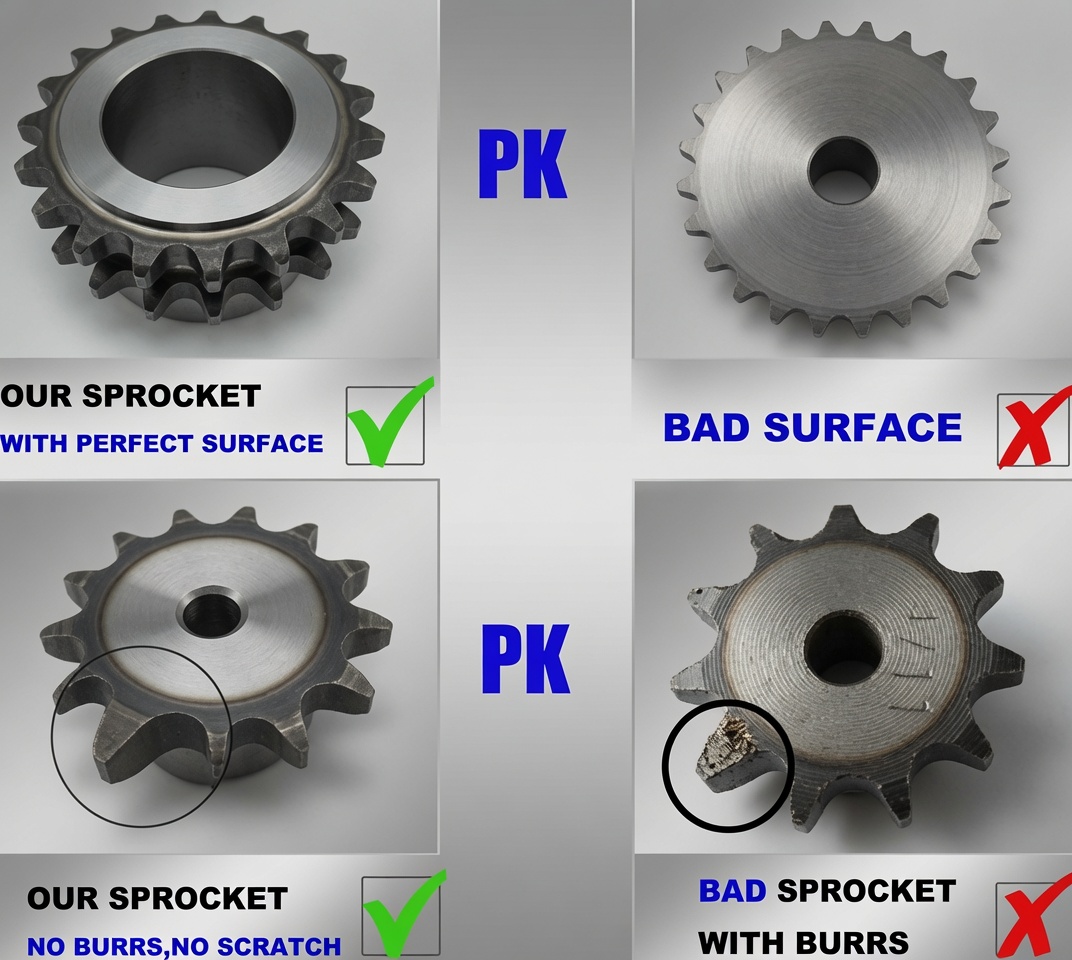
Type B Sprocket: Single-Side Hub Configuration
A Type B sprocket has a hub projection on one side of the sprocket face only. The hub is a cylindrical boss that extends beyond the sprocket face, providing additional shaft contact length, a set-screw boss, and a keyway for positive torque transmission. This is by far the most common sprocket configuration in standard catalogues — the majority of ANSI roller chain sprockets listed in industry catalogues are Type B.
The single hub extends on the side of the sprocket that faces the bearing or adjacent component when installed. The correct orientation (hub facing inward or outward) depends on the specific drive layout and what clearances are required. The convention in most drives is to orient the hub so that it faces away from the nearest adjacent component — toward the open space — to maximise the available distance between the sprocket face and adjacent machine parts.
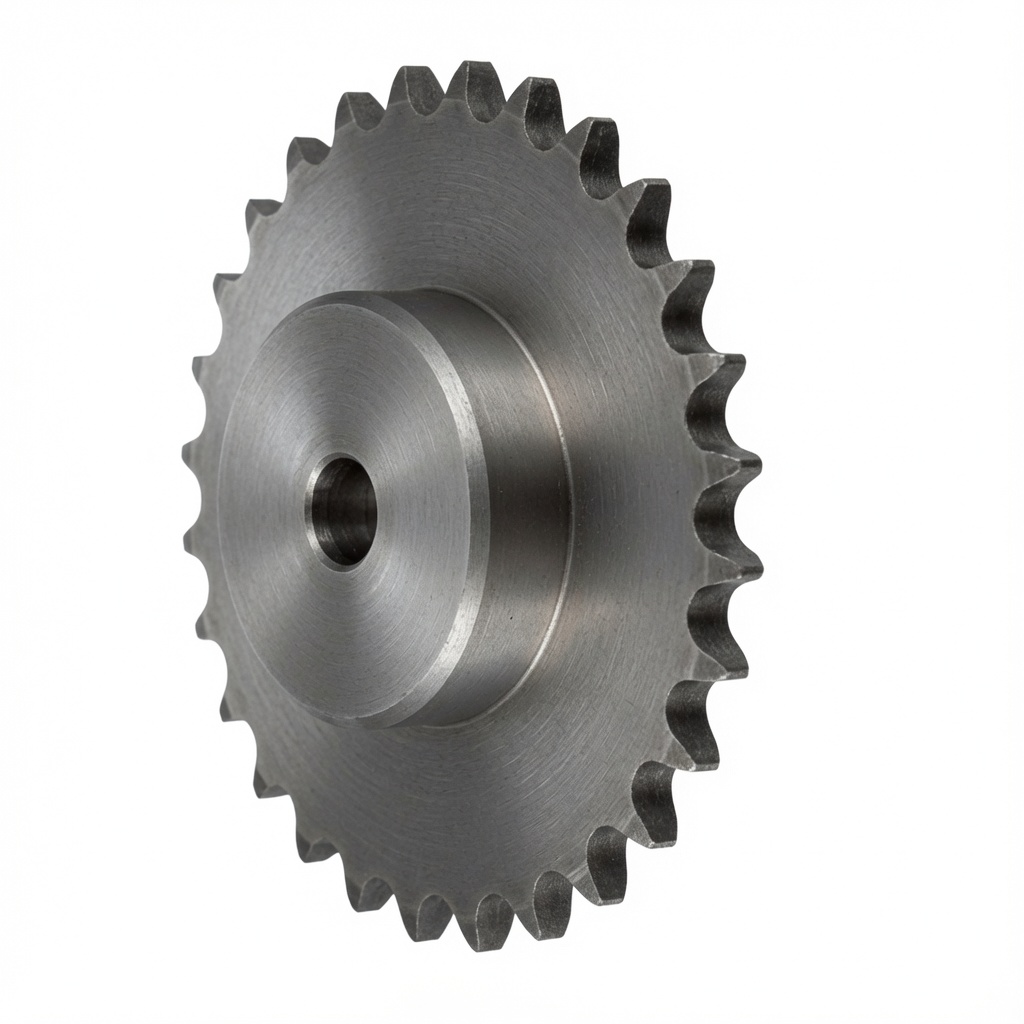
Type C Sprocket: Double-Side Hub Configuration
A Type C sprocket has hub projections on both sides of the sprocket face — a symmetrical configuration with equal hub extensions on each side. Type C sprockets provide the maximum shaft contact length of the three types, which makes them the preferred choice for applications where the chain load or drive torque is high enough to require extended shaft engagement to prevent rocking or fretting on the shaft under cyclic loading.
The symmetrical hub of a Type C sprocket also makes orientation irrelevant — the sprocket can be installed in either axial direction without affecting performance or clearance. This simplifies inventory management for maintenance departments, as a single Type C sprocket can replace a Type B sprocket in either of its two possible orientations. Heavy duty chain sprockets at larger pitches (No.60, No.80, No.100) are frequently specified as Type C because the combination of heavy chain loads and large hub bore diameters benefits from the extended shaft engagement.
Side-by-Side Comparison: Type A vs Type B vs Type C
| Parameter | Type A (Disc/Plate) | Type B (Single Hub) | Type C (Double Hub) |
|---|---|---|---|
| Hub projection | None | One side only | Both sides equal |
| Shaft contact length | Sprocket face width only | Face width + hub projection | Face width + 2× hub projection |
| Keyway provision | Usually none | Yes (standard) | Yes (standard) |
| Set screw provision | Usually none | Yes | Yes |
| Primary use | Idler sprockets; external hub applications | Most standard driven shaft applications | Heavy loads; maximum shaft engagement |
| Width (axial) | Narrowest | Medium | Widest |
| Installation flexibility | Orientation irrelevant (no hub) | Orientation matters (hub direction) | Orientation irrelevant (symmetric) |
| Cost relative to Type B | Similar or slightly lower | Reference | 10–20% higher |
| Availability in small pitches | Limited | Full range | Limited in small pitches |
Choosing the Right Hub Type for Your Application
The correct hub type selection depends on four installation-specific factors that must be evaluated for each drive design. Working through these four questions systematically produces the correct hub type selection in the majority of cases.
Hub Type Designations in Catalogue Entries
When ordering sprockets from a catalogue, the hub type is typically specified as part of the part number suffix or as a separate field in the order form. For example, a No.40 chain, 25-tooth, Type B sprocket with a 1″ bore might be catalogued as “40B25H” or “RS40-25B” depending on the manufacturer’s numbering system. When ordering stainless steel sprockets from Hangzhou Ever-Power, specify hub type (A, B, or C), chain pitch and designation, tooth count, bore diameter, and keyway dimensions (if required) in the order. Our engineering team can confirm the hub dimensions and available bore range for any combination before production.
Non-Standard Hub Configurations and Custom Options
Beyond the three standard hub types, some applications require modified hub configurations that fall outside the A/B/C classification. Extended hub lengths beyond the standard Type C dimensions are available for applications where shaft contact length requirements exceed the standard hub length. Offset hub designs — where the hub is displaced to one side but the sprocket face is centred on the shaft — are used in drives with asymmetric clearance constraints. Flanged hubs with bolt circle patterns for flange-mounted sprockets appear in certain conveyor and food-processing equipment designs.
Custom hub configurations are available from Hangzhou Ever-Power with lead times of 7–14 business days from drawing confirmation. For conveyor sprocket wheels in food processing, pharmaceutical, and other hygienic environments, custom hub profiles that minimise crevices and facilitate cleaning are a common request that our engineering team handles routinely.
Hangzhou Ever-Power manufactures stainless steel, carbon steel, and custom sprockets for global industrial buyers. Low MOQ, full documentation, fast lead times.
SHENHUA ROAD, HANGZHOU, CHINA | +86-571-88220653