
The choice between a split sprocket and a solid sprocket is not primarily about performance — both types, when correctly selected and installed, provide equivalent service life and load capacity in the same drive conditions. The decision is fundamentally about installation and maintenance practicality: where can a solid sprocket be fitted without removing the shaft, and where does a split design make an otherwise impractical installation straightforward? Getting this decision right at the design stage saves significant maintenance time and cost over the life of the machine. Getting it wrong means either a multi-day shaft-removal exercise every time a sprocket needs replacement, or an assembly that vibrates from split-sprocket runout because the drive actually needed a solid.
This article provides a direct, structured comparison covering every practical dimension of the split-versus-solid decision: installation difficulty, maintenance access, load capacity, concentricity, cost, and the specific application types where each design is genuinely the better choice.
The Fundamental Mechanical Difference
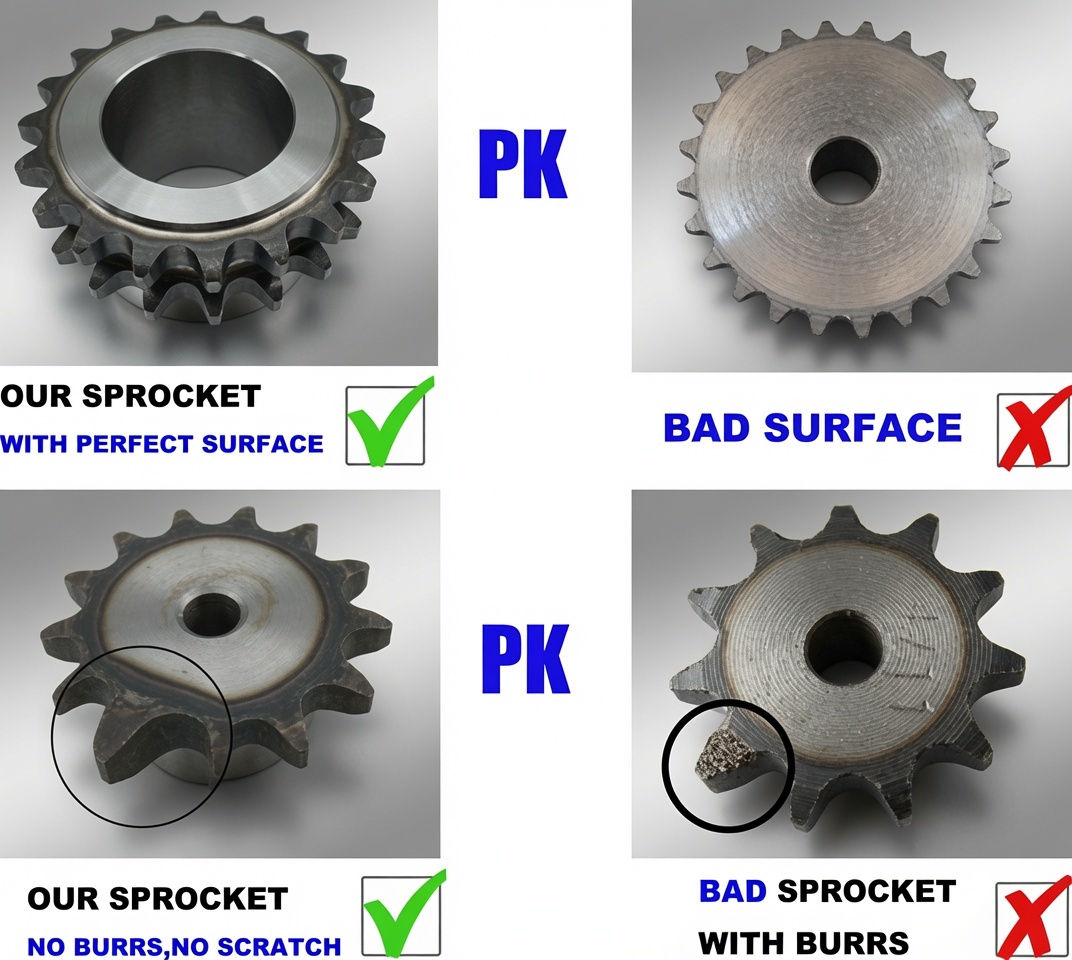
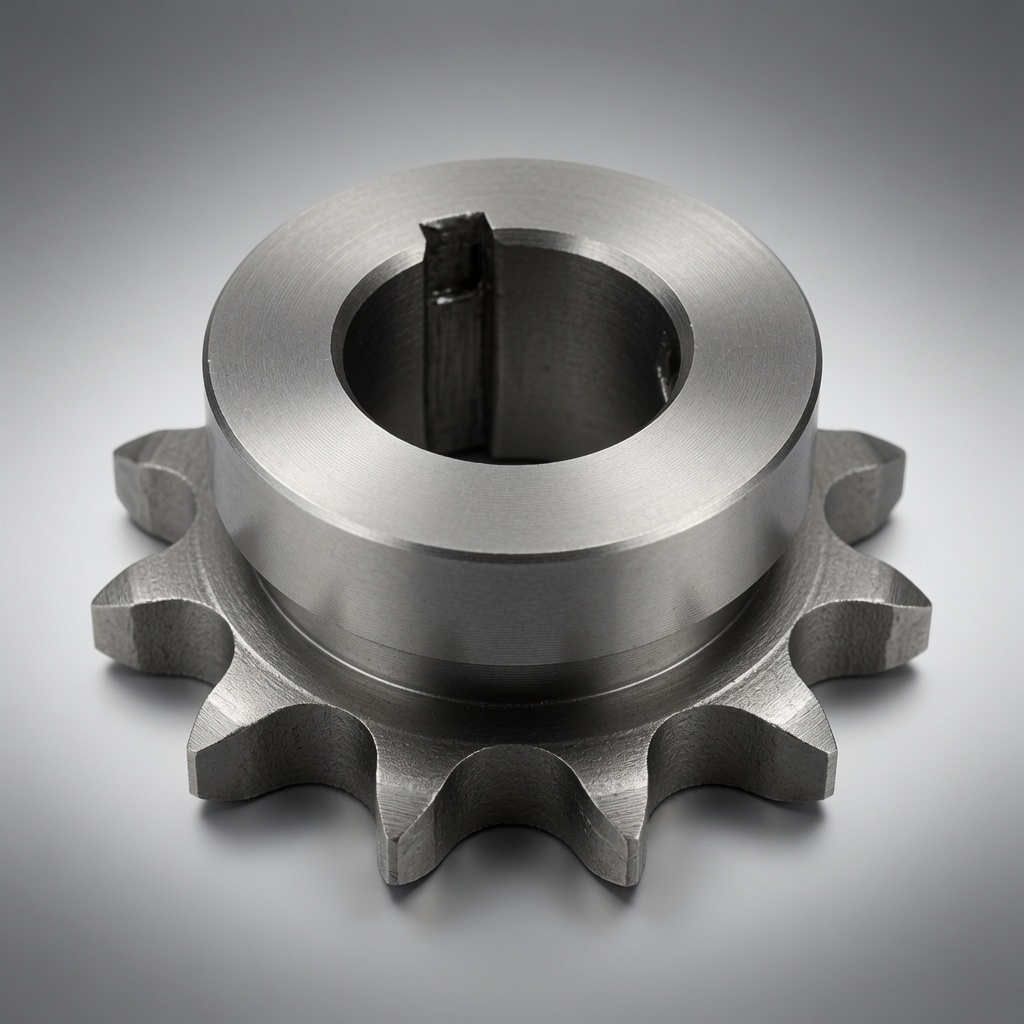
A solid sprocket is machined or forged as a single piece. Its bore is a continuous, precisely toleranced cylindrical surface that mates with the shaft across its full circumference. There is no joint, no bolt, and no structural discontinuity anywhere in the load path from chain to shaft. This monolithic construction is why solid sprockets achieve the lowest runout values and the most consistent bore-to-tooth-tip concentricity — both of which translate directly into smooth, quiet chain engagement. The full range of stainless steel sprockets manufactured at our Hangzhou facility covers solid configurations across all standard ANSI and BS/DIN chain pitches.
A split sprocket is manufactured in two matching halves that bolt together around the shaft at a parting line through the sprocket centre. Each half carries half the teeth, half the hub, and the clamping flanges. When assembled, the bolted joint must clamp the two halves so tightly that the assembly behaves as a single rigid piece under chain load. A correctly installed, correctly torqued split sprocket achieves this — but the joint introduces an inherent source of dimensional variation (half-mating surface flatness, bolt torque distribution, surface contamination) that solid sprockets avoid entirely.
Installation Comparison: Where Each Type Requires More Work
| Scenario | Solid Sprocket | Split Sprocket |
|---|---|---|
| Open shaft end available | Slide onto shaft — fast, straightforward | More complex: assemble halves around shaft, torque bolts |
| No accessible shaft end | Requires shaft removal — hours or days | Assemble radially around shaft — 1–2 hours |
| Multiple components between fixed end bearings | Each inner component needs outer components removed first | Install without moving adjacent components |
| Shaft with integral flanges or welded ends | Cannot install — shaft modification needed | Clamps radially — no end access needed |
| Very heavy sprocket on vertical shaft | Lifting equipment and guided axial installation | Two halves individually lighter; easier handling |
| Precision drive requiring minimum runout | Preferred — lowest runout achievable | Requires careful installation; slightly higher runout |
The table makes clear that for shafts where end access is unrestricted, a solid sprocket is faster and simpler to install. The split design earns its place only when end access is genuinely restricted — not merely inconvenient, but actually impractical without major disassembly.
Maintenance and Replacement: Real-World Time Comparison
The most compelling argument for split sprockets in appropriate applications is the time saving at routine maintenance intervals. The following scenario illustrates a realistic comparison.
Load Capacity: Is There a Real Difference?
In theory, a correctly installed split sprocket has the same load capacity as an equivalent solid sprocket. The chain load is distributed across all engaged teeth simultaneously — the joint does not carry the chain load directly. The two halves are held together primarily by the clamping force of the joint bolts, and a correctly torqued joint provides far more clamping force than the chain tension requires to prevent the halves from separating. Drive chain sprockets in split configuration up to No.80 chain pitch are used in routine main-drive applications without any de-rating of load capacity compared to equivalent solid sprockets.
In practice, three conditions reduce the effective load capacity of a split sprocket below the solid equivalent: incorrect bolt torque, contaminated joint faces, and shock loading. Under-torqued joints allow the halves to micro-shift under peak loads, producing fretting wear at the joint face and progressive joint opening that eventually causes the sprocket to wobble. This is an installation failure, not a design limitation — but it occurs more frequently than solid sprocket failures because it requires correct execution of a multi-step procedure that solid installation does not. For shock-loaded drives, the dynamic torque peaks that occur at each load reversal are more damaging to a split joint than to a solid bore, which is why solid sprockets are preferred for high-shock applications even when shaft access is inconvenient.
Concentricity and Runout: The Precision Question
For drives where sprocket runout produces measurable performance degradation — high-speed drives above 500 RPM on the small sprocket, registration conveyors, precision indexing systems — solid sprockets are preferred. A solid sprocket bored on a CNC turning centre achieves bore-to-pitch-circle runout of 0.001″–0.003″ as standard, with tighter values achievable on request. Chain and sprocket sets for precision drives are always specified as solid configuration for this reason.
A correctly installed split sprocket typically achieves 0.003″–0.008″ runout — adequate for most standard industrial chain drives but measurably higher than solid. The higher value arises from two sources: the tolerance stack of the two half-mating surfaces, and the bolt torque distribution across the joint. Both sources of variation are controllable with careful installation, but cannot be reduced to zero. If a specific runout value below 0.005″ is required, specify a solid sprocket and plan for the shaft access work it requires.
Cost Analysis: When Split Sprockets Pay for Themselves
Decision Guide: Which Type for Your Application?
Hangzhou Ever-Power manufactures stainless steel, carbon steel, and custom chain sprockets for global industrial buyers. Low MOQ, full documentation, fast lead times.
SHENHUA ROAD, HANGZHOU, CHINA | +86-571-88220653