
Every engineer who specifies a chain drive has heard warnings about chordal action, but fewer can explain the phenomenon precisely or quantify how much it matters for a given design. Chordal action is the root cause of the rhythmic speed variation, vibration, and noise that characterise chain drives at moderate-to-high speed — and understanding it quantitatively is the first step toward designing drives that minimise its effects. This article explains the mechanism, the mathematics, and the practical design strategies that experienced drive engineers use to keep chordal action under control.
What Is Chordal Action? The Core Mechanism
When a chain engages a sprocket, each roller does not travel in a perfect circle as it moves through the engagement arc. Instead, the chain spans the gap between consecutive teeth as a straight segment — a chord — rather than following the arc of the pitch circle. As the sprocket rotates, each chain link rises and falls in a small cyclic motion as consecutive rollers seat in successive tooth pockets. This rise-and-fall motion is chordal action, also called polygonal action or chordal rise.
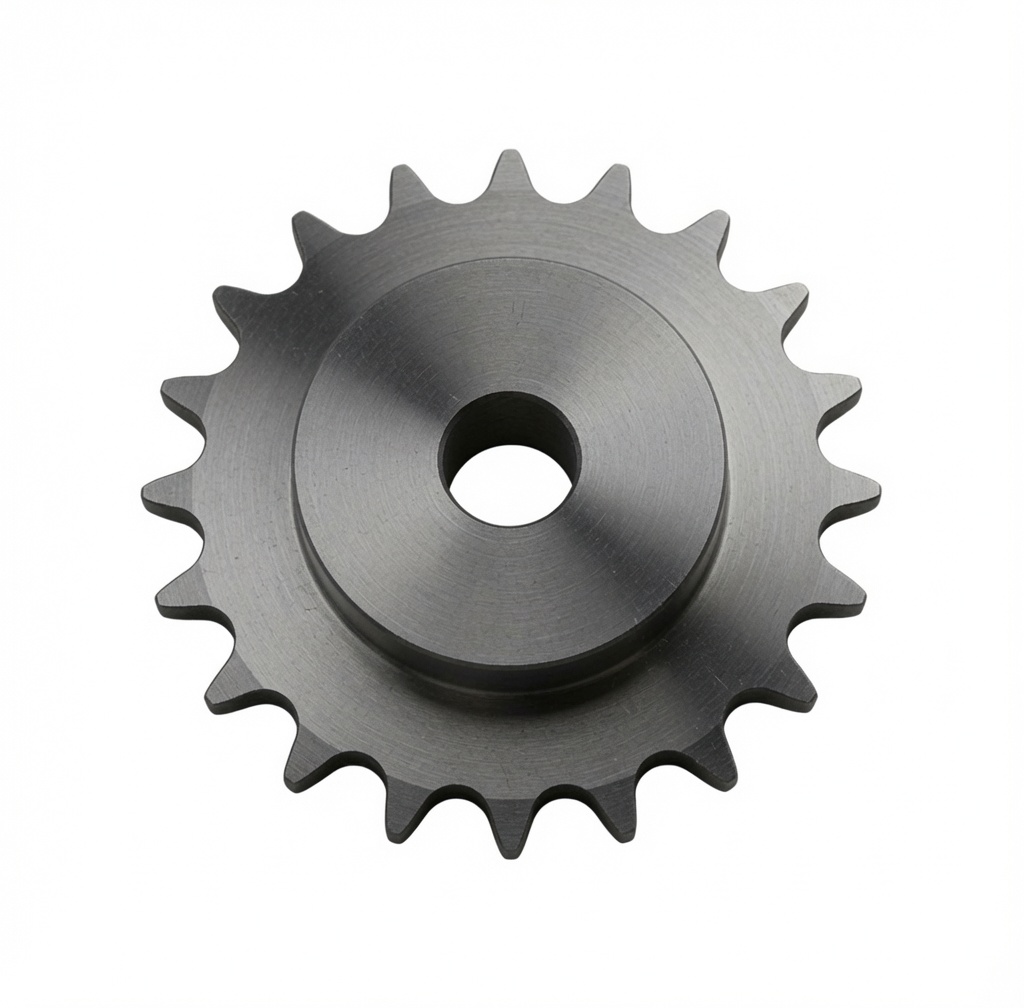
The geometric origin is straightforward: a sprocket is a polygon, not a circle. A 12-tooth sprocket is geometrically a 12-sided polygon. A 24-tooth sprocket is a 24-sided polygon. The difference between the radius of the circumscribed circle (through the tooth tips) and the distance from the centre to the midpoint of each side (the apothem) determines how much the chain rises and falls with each tooth engagement. At the extremes of each tooth interval, the chain hangs at its lowest point; at the moment of roller seating, it rises to its highest. This cyclic variation produces the velocity ripple that is the defining characteristic of chain drives.
The Mathematics of Chordal Action
Chordal Rise Formula
The magnitude of chordal action can be quantified by the chordal rise (h) — the difference in chain height between the highest and lowest positions during one tooth engagement cycle. The formula is:
Where p is the chain pitch and N is the number of teeth. This formula reveals the key relationship: chordal rise decreases rapidly as tooth count increases. For a given pitch, doubling the tooth count reduces chordal rise to a small fraction of its original value.
Velocity Variation Percentage
The percentage speed variation caused by chordal action — the ratio of the maximum instantaneous chain speed to the minimum instantaneous chain speed — follows a similar relationship:
| Tooth Count (N) | Chordal Rise / Pitch | Speed Variation (%) | Suitability |
|---|---|---|---|
| 9 | 0.0603 | 6.0% | Slow-speed only; significant vibration |
| 12 | 0.0341 | 3.4% | Low speed; acceptable with isolation |
| 17 | 0.0171 | 1.7% | Standard minimum for most drives |
| 19 | 0.0137 | 1.4% | Good for moderate-speed drives |
| 25 | 0.0079 | 0.8% | Suitable for most industrial applications |
| 35 | 0.0040 | 0.4% | Low chordal action; suitable for high speed |
| 48 | 0.0022 | 0.2% | Very low; suitable for precision drives |
Why Chordal Action Matters in Practice
The practical consequences of chordal action extend beyond simple vibration. For chain drive sprockets in real industrial installations, chordal action creates four interconnected problems that compound each other over the drive’s service life.

How to Minimise Chordal Action: Practical Design Strategies
Experienced conveyor chain sprockets designers use several interconnected strategies to minimise the effects of chordal action without necessarily increasing sprocket size beyond what the application requires.
Strategy 1: Use the Largest Practical Tooth Count on the Small Sprocket
The small sprocket (driver) dominates chordal action in a drive because it has the lowest tooth count. Industry practice is to specify at minimum 17 teeth on the small sprocket for any drive above very low speeds, and to use 19, 21, or 25 teeth wherever the resulting sprocket diameter and chain length are acceptable. The marginal reduction in chordal action diminishes rapidly above 25 teeth, so there is rarely a justification for using more than 30–35 teeth on a drive sprocket purely to reduce chordal action.
Strategy 2: Select a Smaller Chain Pitch at Higher Tooth Count
For a given power requirement and speed, a smaller chain pitch running on a larger tooth count sprocket produces less chordal action than a larger pitch on fewer teeth. A No.40 (1/2″) chain running on a 24-tooth sprocket produces significantly less chordal action than a No.60 (3/4″) chain on a 17-tooth sprocket transmitting the same power. This pitch-reduction / tooth-count-increase approach is a standard technique for reducing chain drive noise in applications where sound levels matter.
Strategy 3: Use an Odd Number of Teeth on the Driver
An odd tooth count on the driver sprocket, combined with an even (or at least non-integer-multiple) tooth count on the driven sprocket, prevents any single roller from repeatedly engaging the same tooth on the sprocket. This tooth-hunting effect distributes wear evenly across all teeth and all rollers, which delays the development of localised wear patterns. It does not reduce chordal action mathematically, but it extends the service life of both chain and sprocket by ensuring even wear distribution — a closely related concern for drive designers.
Strategy 4: Maintain Correct Chain Tension
A sagging chain amplifies the dynamic effects of chordal action. When the slack span sags excessively, the velocity-change impact at each tooth engagement is transmitted more directly to the chain links rather than being partially absorbed by controlled chain span vibration. Maintaining chain sag within the recommended limits (typically 1–2% of chain span length for horizontal drives) reduces the severity of impact loading from chordal action.
Chordal Action in High-Speed and Precision Applications
For ANSI roller chain sprockets running at speeds above 500 RPM on the small sprocket, chordal action becomes the dominant design constraint rather than chain tensile load capacity. Drive engineers in precision industries — pharmaceutical packaging, electronic component handling, registration conveyors — often find that the required tooth count for acceptable chordal action forces them to a larger physical sprocket than the torque calculation alone would suggest. In these cases, the alternative of switching from roller chain to a synchronous timing belt drive should be seriously evaluated, since timing belt drives have no chordal action by virtue of their continuous meshing tooth-belt contact geometry.
Summary: Key Rules for Controlling Chordal Action
Hangzhou Ever-Power manufactures stainless steel, carbon steel, and custom sprockets for global industrial buyers. Low MOQ, full documentation, fast lead times.
SHENHUA ROAD, HANGZHOU, CHINA | +86-571-88220653