The split sprocket is one of those components that most maintenance engineers never think about until they are confronted with a shaft installation problem that a conventional solid sprocket simply cannot solve. Once that situation arises — a bearing housing that cannot be easily disassembled, a shaft that carries multiple components between fixed end bearings, a conveyor that cannot be shut down long enough for shaft removal — the split sprocket transforms what would be a multi-day engineering intervention into a two-hour maintenance task. This article explains what a split sprocket is, precisely where it is advantageous, and the engineering considerations that govern its selection and installation.
What Is a Split Sprocket? A Physical Description
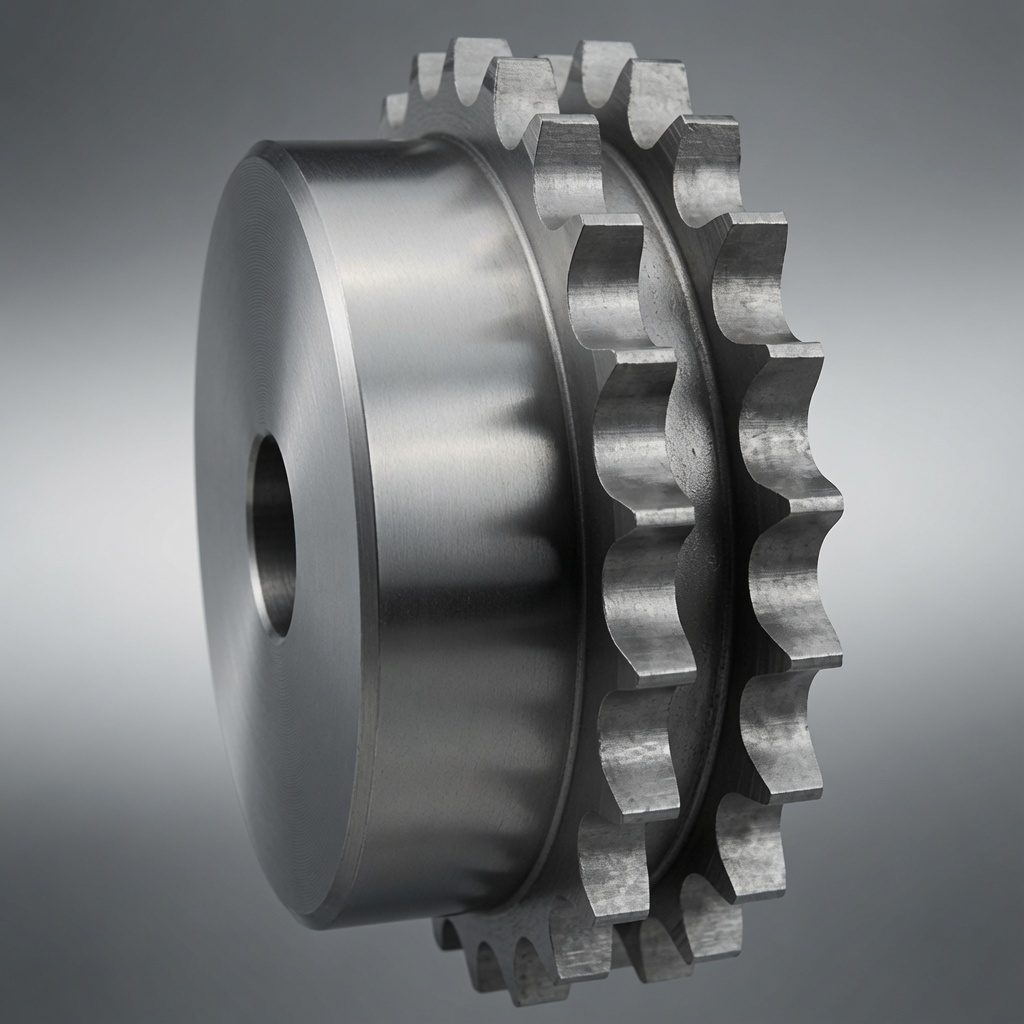
A split sprocket is a sprocket manufactured in two halves that bolt together around the shaft rather than sliding onto the shaft from the end. Each half carries half of the sprocket teeth, half of the hub, and the bolt flanges required to join the two halves into a complete sprocket assembly. When the bolts are properly torqued, the assembled split sprocket performs mechanically identically to an equivalent solid sprocket — the joint between the two halves is not a weak point in the load path when correctly installed, because the chain load is distributed across all engaged teeth simultaneously and the bolts carry only the clamping load that maintains the two halves in position.
The split plane typically bisects the sprocket along a diameter, producing two mirror-image halves. In some designs, the split is offset from the centre bore axis by a small angle to prevent the split line from coinciding with any single tooth — ensuring that no tooth is split across the joint line where material discontinuity might affect tooth load capacity. This offset design is a quality indicator for split sprockets intended for heavy-duty applications.
Why Use a Split Sprocket? The Core Application Cases
The primary reason to specify a split sprocket over an equivalent solid sprocket is shaft accessibility — specifically, when the shaft arrangement makes it impractical to install or remove a solid sprocket from the shaft end. Heavy duty chain sprockets in the following situations are prime candidates for the split design.
C1
Shaft-Mounted Components Between End Bearings
When multiple gears, couplings, pulleys, and sprockets are mounted between two fixed-end bearings, removing the innermost component requires dismounting all outer components first. A split sprocket can be installed or removed without disturbing any adjacent components.
C2
Non-Removable or Difficult-to-Remove Shaft Ends
Some shafts have integral flanges, welded components, or threaded end fittings that prevent axial movement of a solid sprocket. A split sprocket installs radially around the shaft, bypassing the end constraint entirely.
C3
Long Shafts with Many Keyways or Splines
On long conveyor shafts with multiple keyway locations, sliding a solid sprocket over multiple keyways risks damaging the bore surface or the shaft keyways during installation. A split sprocket avoids this entirely.
C4
Continuous Process Lines Where Shaft Removal Means Long Downtime
Food processing, paper manufacturing, and continuous chemical processing lines cannot afford the downtime associated with full shaft removal for a routine sprocket replacement. A split sprocket reduces replacement time from several hours to under two hours in most installations.
C5
Very Heavy Sprockets on Vertical Shafts
A large, heavy solid sprocket installed on a vertical shaft requires lifting equipment and careful alignment during installation. Two half-assemblies of a split sprocket are individually lighter and easier to handle in confined vertical shaft access environments.
How a Split Sprocket Is Installed: Step-by-Step Procedure
The installation procedure for a split sprocket is more involved than sliding a solid sprocket onto a shaft and securing with a keyway and set screws, but it eliminates the need to access the shaft end. The following sequence applies to the most common bolted-flange split sprocket design.
1
Prepare the Shaft
Clean the shaft surface where the sprocket will sit. Remove any rust, paint, or surface damage that would prevent the split halves from seating flush. Check that the shaft diameter is within the sprocket bore tolerance specification.
2
Install the First Half
Position the first half of the split sprocket against the shaft at the correct axial location, with the keyway (if used) aligned with the shaft key. The half should sit squarely on the shaft without rocking.
3
Thread the Chain (If Required)
If the chain is already installed, thread it around the first half of the sprocket before installing the second half. This is one of the key advantages of split sprockets in chain replacement applications — the chain does not need to be broken.
4
Install the Second Half
Bring the second half into position, aligning the bolt holes in the flanges. Ensure that the split joint faces meet cleanly with no gap or step. The tooth profile should align smoothly across the joint.
5
Install and Torque Bolts in Sequence
Install all joint bolts finger-tight, then torque them in the sequence specified by the manufacturer — typically alternating across the joint to pull both halves together evenly. Final torque value is specified in the manufacturer’s documentation.
6
Verify Concentricity and Runout
After installation, rotate the sprocket by hand and check for runout with a dial gauge. Runout above 0.005″ (0.13 mm) for standard drives or 0.002″ (0.05 mm) for precision drives indicates a misaligned or incorrectly torqued joint.
Split Sprocket vs. Solid Sprocket: Direct Comparison
| Parameter |
Solid Sprocket |
Split Sprocket |
| Installation method |
Axial (from shaft end) |
Radial (clamped around shaft) |
| Shaft accessibility required |
Full access to one shaft end |
Access to shaft circumference only |
| Load capacity |
Full rated capacity |
Full rated capacity when correctly torqued |
| Cost |
Lower |
20–50% higher than equivalent solid |
| Installation time (accessible shaft) |
30–60 minutes |
90–120 minutes |
| Installation time (inaccessible shaft end) |
Hours to days (shaft removal) |
90–120 minutes |
| Runout after installation |
Low (machined bore) |
Slightly higher (depends on joint alignment) |
| Suitability for precision drives |
Preferred |
Acceptable with careful installation |
| Maximum available sizes |
All standard sizes |
Large sizes; less common in small pitches |
Engineering Considerations for Split Sprocket Selection
Selecting a split sprocket for a given application involves verifying several engineering parameters beyond the standard tooth count and bore specification that apply to any drive chain sprockets.
Joint Bolt Torque and Material
The joint bolt torque is critical — under-torqued bolts allow the two halves to shift relative to each other under chain load, producing fretting wear at the joint faces and progressive misalignment. Over-torqued bolts risk stripping threads in cast iron sprocket flanges or inducing stress concentrations at the bolt holes. Always follow the manufacturer’s torque specification for the specific bolt size and material combination.
Split Sprocket Bore Tolerance After Assembly
Split sprockets are typically bored as an assembled unit after casting or forging the two halves, ensuring that the bore is concentric and round in the assembled condition. If a split sprocket is disassembled and reassembled incorrectly — with the halves swapped or misoriented — the bore will not be round and will not fit the shaft correctly. Mark the halves with orientation marks during the first installation to ensure correct reassembly.
Surface Finish at the Split Joint
The mating faces of the two halves must be clean and flat for the assembly to achieve its design concentricity. Corrosion, paint, or debris on the joint faces prevents the halves from seating correctly and produces runout in the assembled sprocket. Clean the joint faces with solvent before every reinstallation.
When Not to Use a Split Sprocket
Despite the installation advantages of split sprockets, there are applications where solid sprockets should be specified even if shaft access is difficult — and where the inconvenience of shaft removal is preferable to the engineering compromises of split construction.
High-Speed Precision Drives
The joint in a split sprocket introduces a small but measurable runout that makes split sprockets less suitable than solid sprockets for high-speed drives above approximately 500 RPM on the small sprocket, or for drives where runout must be below 0.002″ for registration or precision positioning applications.
Very Small Pitch (No.25 / No.35)
Split sprockets at small pitches are difficult to manufacture with sufficient joint precision, as the teeth and hub are small relative to the bolt flanges required for the joint. Solid sprockets are preferred for pitches below 1/2″ except in very specific inaccessible-shaft situations.
Severe Shock Loading
Reversing drives with high shock loads impose cyclic stress concentrations at the split joint that may fatigue the joint flange bolts or produce progressive joint opening under repeated shock. Solid sprockets are more robust in these conditions.
Hygienic Applications
The joint gap in a split sprocket, even when tightly bolted, can trap food particles, cleaning chemicals, or biological material that is difficult to remove in CIP procedures. Solid stainless sprockets are preferred for food-grade conveyor drives where hygiene standards require surfaces that are fully cleanable without disassembly.
Need Industrial Sprockets? Get a Factory-Direct Quote
Hangzhou Ever-Power manufactures stainless steel, carbon steel, and custom sprockets for global industrial buyers. Low MOQ, full documentation, fast lead times.
SHENHUA ROAD, HANGZHOU, CHINA | +86-571-88220653
Frequently Asked Questions
1. Can I convert my existing solid sprocket drive to a split sprocket without other changes?+
In most cases, yes. A split sprocket of the same pitch, tooth count, and bore diameter is mechanically equivalent to the solid sprocket it replaces. The only installation difference is the assembly procedure. However, verify that the split sprocket flanges do not create interference with adjacent components that the thinner-profile solid sprocket avoided.
2. Do split sprockets wear faster than solid sprockets?+
When correctly installed and maintained, a split sprocket does not wear significantly faster than an equivalent solid sprocket. The potential weak point is the joint, which can develop fretting wear if the bolts are under-torqued or if the joint faces are not clean and flat at assembly. Correctly installed split sprockets have service lives comparable to solid sprockets in the same application.
3. How do I know when a split sprocket joint needs re-torquing?+
Inspect the joint at each scheduled maintenance interval. Signs that re-torquing is needed include: visible gap at the joint faces, audible clicking as the sprocket rotates under load, detectable runout increase on dial gauge inspection, or fretting rust marks at the joint face edges. Re-torque to the specified value and mark the bolt heads with a paint pen to make joint movement visible at the next inspection.
4. Are split sprockets available in stainless steel?+
Yes. Split sprockets are available in 304 and 316 stainless steel for food processing, pharmaceutical, and wash-down applications where corrosion resistance is required. The split design does introduce more hygiene risk than a solid sprocket (joint gap), so evaluate whether the shaft access problem truly requires a split design before specifying stainless split sprockets in hygienic environments.
5. What is the maximum recommended chain speed for a split sprocket?+
Most split sprocket manufacturers recommend a maximum of approximately 300–500 RPM on the sprocket (not chain speed) for standard bolt-flange split designs. Above this speed, dynamic imbalance from joint asymmetry and the increased severity of any runout in the assembly become limiting factors. High-speed versions with precision-balanced halves are available for specific applications.
Hangzhou Ever-Power Sprocket Chain Co., Ltd.
