In the design of chain drives, the idler sprocket occupies an often overlooked but mechanically important position. Where the drive sprocket and driven sprocket are the two principal actors in power transmission, the idler sprocket is a supporting player that enables drive arrangements that would otherwise be impractical or mechanically unreliable. Understanding exactly what an idler sprocket does — and equally, what it should not be asked to do — helps engineers design more reliable chain drive systems and troubleshoot problems that originate in idler placement and specification.
Defining the Idler Sprocket
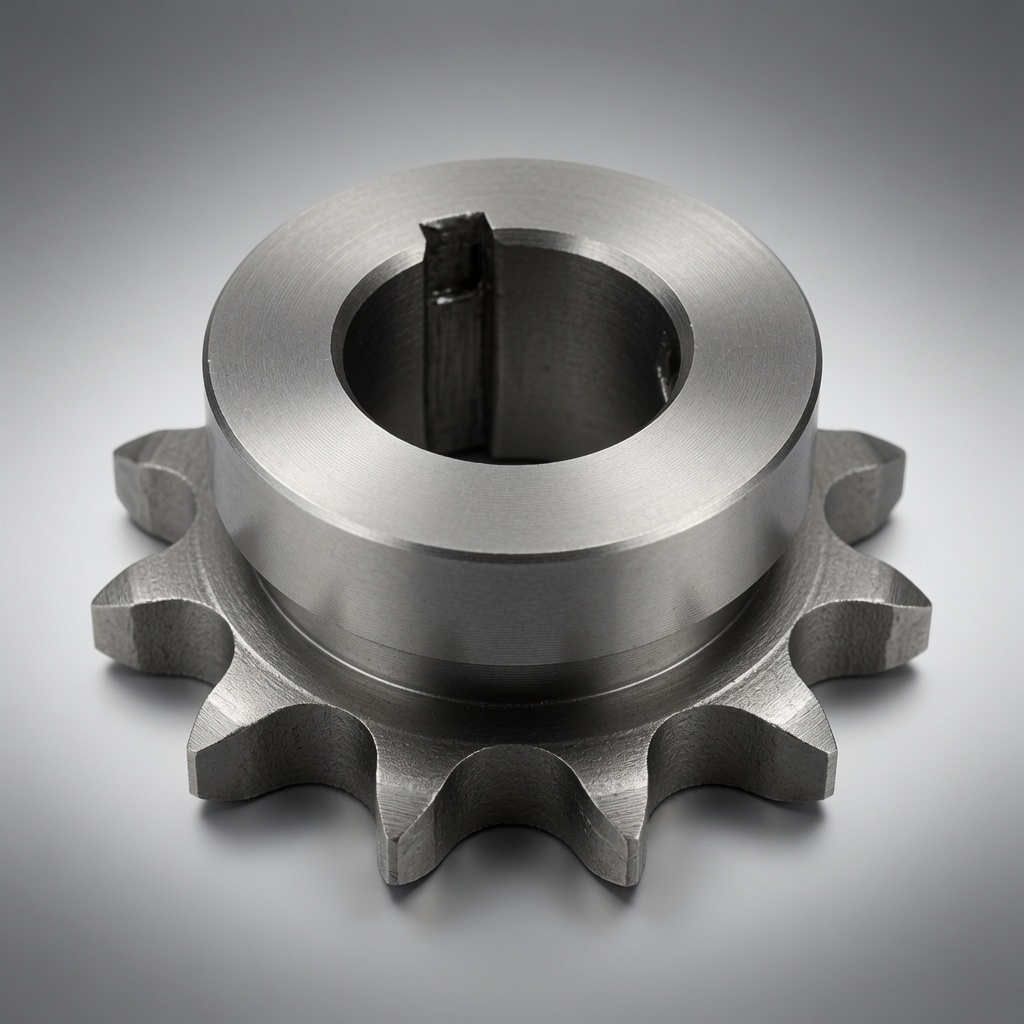
An idler sprocket is a sprocket that engages the chain without being connected to a driving or driven shaft in the power transmission path. It does not input power to the chain and does not extract power from it. Its sole mechanical function is to redirect or tension the chain, or to support the chain across a span that would otherwise allow excessive sag. The idler sprocket turns freely on its shaft, driven only by the chain contact rather than by an external power source.
The distinction between an idler and a drive/driven sprocket is functional, not physical. An idler sprocket is the same component as a power transmission sprockets in terms of tooth form, material, and dimensional specification — the difference is only in how it is mounted and what role it plays in the drive layout. A plain-bore (no keyway) mounting is typical for idler sprockets, since they need to turn freely on a fixed shaft rather than transmit torque to or from the shaft.
The Four Functions of an Idler Sprocket
Function 1: Chain Tensioning
The most common idler application is maintaining chain tension on the slack side of the drive. A spring-loaded idler presses against the slack span and compensates for chain elongation as the chain wears, maintaining correct tension without manual adjustment. This is particularly valuable in drives where the centre distance cannot be adjusted to take up chain slack.
Function 2: Chain Redirection
An idler sprocket can redirect the chain around obstacles, through angles, or into non-straight drive paths that a direct two-sprocket drive cannot achieve. This allows chain drives to be routed around machine structures, through tight spaces, and in configurations where the drive shaft and driven shaft are not in a simple parallel arrangement.
Function 3: Increasing Chain Wrap Angle
When the drive and driven sprockets are very close together or have a large size difference, the chain wrap angle on the small sprocket can be dangerously low — reducing the number of teeth engaged simultaneously and increasing the load per tooth. An idler placed to push the chain inward on the slack side increases the wrap angle on the small sprocket, improving load distribution.
Function 4: Span Support
On long chain drives with large centre distances, the chain span can sag excessively under its own weight, creating dynamic problems as the sag oscillates during operation. An idler sprocket or idler rail placed midspan supports the chain weight and limits sag to acceptable levels without increasing chain tension.
Where Idler Sprockets Should Be Placed
The placement of idler sprockets in a chain drive is governed by a set of principles that ensure the idler achieves its intended purpose without introducing new problems. Conveyor sprocket wheels used as idlers on conveyor layouts follow these placement rules in the vast majority of standard installations.
R1
Place on the Slack Side, Not the Tight Side
An idler sprocket used for tensioning should be placed on the slack side of the chain — the span that returns from the driven sprocket to the drive sprocket without carrying load. Placing a tensioning idler on the tight (load-carrying) side increases chain tension above the calculated working tension and adds unnecessary load to the idler bearings.
R2
Apply Force from the Outside (Inward) for Tensioning
A spring-loaded tensioning idler should push the chain inward toward the centerline of the drive. Applying the idler force outward (away from the drive centerline) on the slack side would push the chain away from the straight span, creating a reverse bend that reduces chain life.
R3
Apply Force from the Inside (Outward) for Wrap Angle Increase
When the idler purpose is to increase chain wrap angle on the small sprocket, it should push from inside the chain loop outward, increasing the angle of wrap. This is the configuration used when the drive ratio is very large and the small sprocket has fewer than 17 teeth engaged.
R4
Maintain Minimum Chain-to-Idler Contact Angle
The chain should engage at least 3 teeth on the idler sprocket at all times. If the chain contact angle on the idler is less than approximately 90° (corresponding to fewer than 3 teeth for a 12-tooth idler), the chain may slip off the idler teeth under dynamic conditions.
R5
Match Idler Tooth Count to Minimum Recommended
Idler sprockets should have at least 12–15 teeth to avoid excessive chordal action at the idler engagement point. Higher tooth counts on idler sprockets reduce wear and noise at the idler.
Fixed vs. Spring-Loaded Idler Sprockets
Idler sprockets are mounted in two fundamentally different ways, and selecting the correct type for a given application is as important as selecting the correct tooth count and material.
| Parameter |
Fixed Idler |
Spring-Loaded Idler |
| Mounting |
Fixed position on adjustable bracket |
Pivot arm with spring or gravity loading |
| Chain tension control |
Set at installation; manual adjustment needed as chain elongates |
Automatically compensates for chain elongation |
| Best application |
Where centre distance is adjustable for take-up |
Where centre distance is fixed and chain must self-tension |
| Maintenance |
Periodic manual re-tensioning required |
Minimal; spring condition should be checked annually |
| Cost |
Lower initial cost |
Higher initial cost; lower maintenance cost over service life |
| Risk |
Chain goes slack if elongation not corrected |
Over-compression of spring at end of travel if chain elongates beyond idler range |
Idler Sprocket Material and Specification Considerations
Idler sprockets are sometimes specified at a lower material grade than drive sprockets, on the assumption that they carry less load. This reasoning is partially correct but can lead to under-specification. While idler sprockets do not transmit torque, they do carry the chain contact load across their tooth faces and their bearing journals. In wash-down environments where stainless steel sprockets are required for drive sprockets, idler sprockets must also be stainless steel — a corroding idler contaminates the chain and environment just as surely as a corroding drive sprocket.
The idler bearing is the component most frequently overlooked in idler specification. The chain contact force acts as a radial load on the idler shaft bearing, and this load can be substantial on high-tension drives with spring-loaded idlers. Selecting a bearing rated for the calculated contact load, with appropriate sealing for the operating environment, is as important as selecting the correct idler sprocket tooth count and material.
Common Idler Sprocket Mistakes and How to Avoid Them
Mistake 1: Too Few Teeth on the Idler
Using an idler with fewer than 12 teeth produces severe chordal action at the idler engagement point, causing vibration and accelerated wear on the chain rollers and idler teeth. Always use at least 12 teeth, preferably 15 or more, on idler sprockets.
Mistake 2: Tight-Side Idler Placement
Placing a tensioning idler on the tight side of the chain more than doubles the total chain tension and dramatically increases bearing loads on the idler and both drive shafts. Always place tensioning idlers on the slack side.
Mistake 3: Incorrect Idler Bore — Shaft Play
An idler mounted on a plain bore without a bearing, relying on shaft clearance for rotation, experiences severe pin wear and chain-to-shaft fretting. Always mount idlers on proper ball or roller bearings suited to the radial load from chain contact.
Mistake 4: Ignoring Idler in Lubrication Programme
On drives that are periodically manually lubricated, idler bearings are frequently forgotten. Idler bearing failure from lack of lubrication is a common, preventable cause of chain drive downtime.
Idler Sprockets in Specific Drive Configurations
The range of applications where idler sprockets solve practical drive layout problems is broad. Double pitch conveyor sprockets in overhead conveyor layouts routinely use multiple idlers to route the chain around curve sections, maintain tension across long horizontal spans, and increase wrap angle at the head shaft where the drive sprocket must engage a heavily loaded chain. In agricultural equipment, idler sprockets route power take-off chain drives around structural members of the machine frame that would otherwise interfere with a direct drive path.
Need Industrial Sprockets? Get a Factory-Direct Quote
Hangzhou Ever-Power manufactures stainless steel, carbon steel, and custom sprockets for global industrial buyers. Low MOQ, full documentation, fast lead times.
SHENHUA ROAD, HANGZHOU, CHINA | +86-571-88220653
Frequently Asked Questions
1. Can an idler sprocket be used on the tight side of a chain drive?+
Technically yes, but it significantly increases chain tension and bearing loads on both the idler and the drive shafts. In most applications, a tight-side idler does more harm than good. The exception is when the idler purpose is specifically to increase wrap angle on the small sprocket — in this case, an inside-pushing idler on what would otherwise be the tight-side span may be appropriate, but the additional tension increase must be accounted for in the chain load rating.
2. What tooth count should I specify for an idler sprocket?+
A minimum of 12 teeth is recommended to avoid excessive chordal action at the idler contact point. For high-speed drives or applications where chain noise is a concern, specify 15 or more teeth. The idler tooth count does not affect the speed ratio of the drive, so there is no functional disadvantage to using a large tooth count on an idler.
3. Does the idler sprocket need to match the drive sprocket material?+
In corrosive or hygienic environments — food processing, pharmaceutical, wash-down applications — yes. All sprockets that contact the chain must be the same corrosion-resistant material, regardless of whether they are drive or idler sprockets. In dry industrial environments, idler sprockets can sometimes be specified in a less expensive material than the drive sprockets if the operating conditions justify it.
4. How is a spring-loaded idler adjusted when the chain reaches its wear limit?+
Spring-loaded idlers compensate automatically for chain elongation up to the spring’s travel limit. When the idler arm reaches the end of its travel range, the chain has elongated to its maximum compensatable length and must be replaced. Most spring-loaded idler designs have a visual indicator or travel stop that signals when the chain replacement interval has been reached.
5. Can I use a smooth wheel instead of a toothed sprocket as a chain idler?+
A smooth idler wheel (sometimes called a chain guide roller) can be used on the back of the chain — the outer face of the link plates rather than the inner roller face. This configuration avoids tooth engagement entirely and is used to redirect chain at very shallow angles or to support chain across long spans. However, smooth rollers should only contact the outer plate face, never the roller side, as roller-to-smooth-surface contact causes rapid roller wear.
Hangzhou Ever-Power Sprocket Chain Co., Ltd.
