Two sprocket mounting systems dominate modern industrial machinery: the Quick Detach (QD) bushing and the Taper Lock bushing. On the surface they look similar — both are tapered sleeves that compress a sprocket hub onto a shaft — but the engineering differences between them are significant enough to make one clearly superior for specific installation conditions. Engineers who treat QD and Taper Lock as interchangeable alternatives frequently end up with under-specified assemblies, unexpected removal difficulties, or costly downtime when a wrong selection meets a real industrial environment.
This article draws a clear line between the two systems: how each works mechanically, where each performs best, and the specific installation and removal differences that determine which system fits a given application. If you are designing a new machine or specifying replacement hardware for existing equipment, the decision between QD and Taper Lock deserves more than a price comparison.
How the QD Bushing System Works
The Quick Detach bushing — sometimes written as QD bushing or simply Q-D — is a tapered, split sleeve that fits into a matching tapered bore in the sprocket, sheave, or coupling hub. Like the Taper Lock, it generates its holding force from wedge self-locking: as the bushing is drawn axially into the hub taper by the flange bolts, the split sleeve compresses around the shaft, locking the assembly without relying on friction alone at the bore. Our heavy duty roller chain sprockets in larger pitches are frequently ordered with QD bores for heavy-torque main-drive applications.
The critical distinction from Taper Lock is the bolt pattern. QD bushings use three or more cap-head bolts threaded through the hub face and into the bushing flange — meaning the bolts pass from the hub outer face into the bushing. To release a QD assembly, the installation bolts are removed and re-inserted into the release holes (in the bushing flange) where they bear against the hub face, jacking the bushing axially out of the hub taper. This two-role bolt system is the defining mechanical feature of the QD design.
How the Taper Lock Bushing System Works
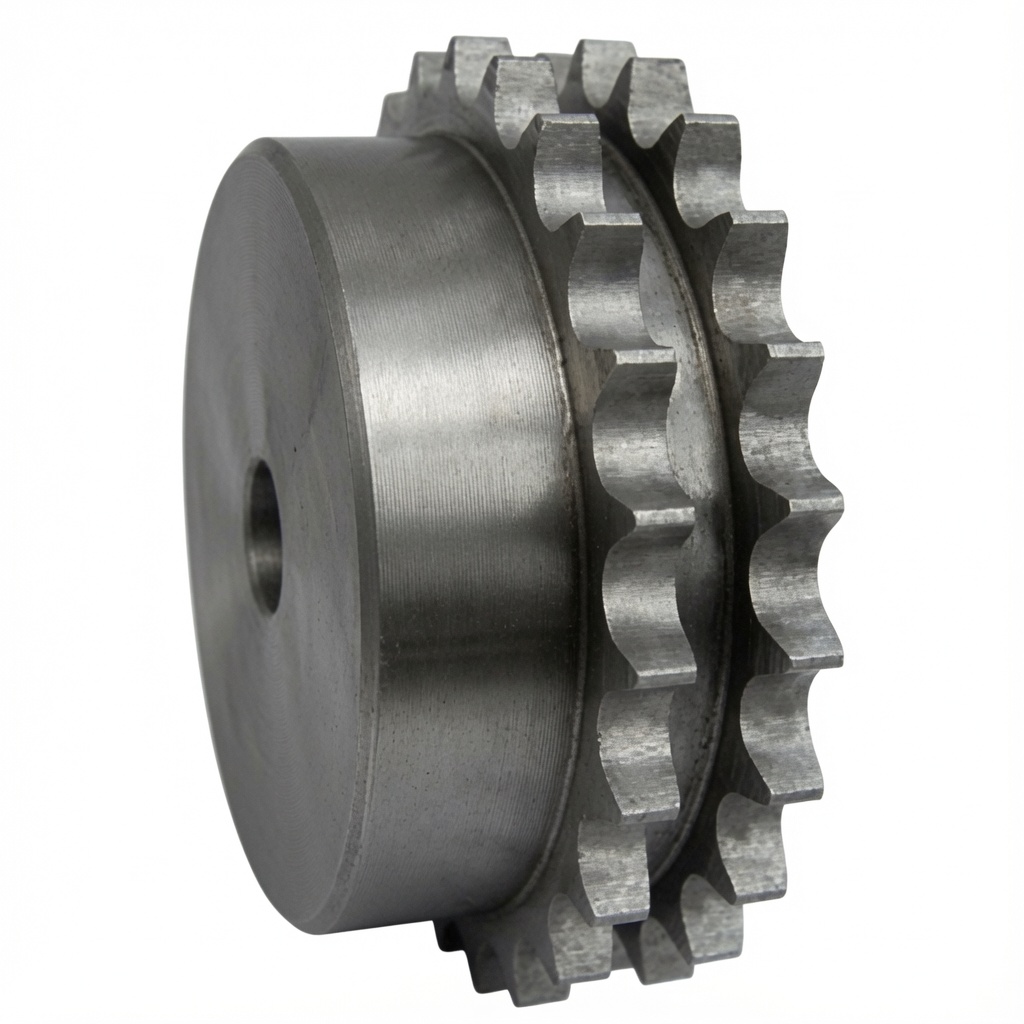
The Taper Lock bushing is a slightly different wedge-and-split sleeve design where the installation bolts thread into the bushing flange and pass through plain (smooth) holes in the hub body. Tightening these bolts draws the bushing taper into the hub taper from the front face of the assembly. Release is achieved by moving these same bolts to the release holes — plain holes in the bushing that align with threaded holes in the hub face — where tightening them pushes the bushing axially back out of the hub taper. Industrial chain sprockets in the No.40 through No.60 range most commonly use Taper Lock bores in the 1008 through 2517 bushing designation range.
The Taper Lock system is older, more widely standardised across manufacturers, and available in a wider range of small bushing sizes than the QD system. The smaller bushings (1008, 1108, 1210) have no equivalent in the QD range, making Taper Lock the only bushing option for smaller sprockets at lighter pitches.
Key Differences: QD vs Taper Lock Side by Side
| Parameter |
QD Bushing |
Taper Lock Bushing |
| Bolt direction |
Hub face to bushing (bolts thread into bushing) |
Bushing flange to hub (bolts thread into hub) |
| Available sizes |
Medium to large (smallest: JA/SH) |
All sizes including small (1008 upward) |
| Holding torque |
Very high — thick flange, more bolts |
High — adequate for most applications |
| Standardisation |
Multiple manufacturers; some dimensional variation |
Highly standardised; inter-manufacturer compatible |
| Small bore availability |
No — minimum approximately 7/8″ shaft |
Yes — available from 1/2″ shaft upward |
| Removal ease |
Easy — dedicated release holes in bushing |
Easy — dedicated release holes in hub |
| Hub bore diameter |
Larger (to accommodate thicker bushing wall) |
Smaller (thinner bushing wall) |
| Typical application |
Large sprockets, heavy industrial, V-belt sheaves |
All sizes; universal sprocket application |
| Cost |
Higher per unit |
Lower per unit; widely available |
Where QD Bushings Outperform Taper Lock
The QD system has specific advantages that make it the preferred choice in identifiable application categories. Understanding these cases helps justify the higher per-unit cost of QD hardware when the application genuinely calls for it.
Heavy Torque Main Drives
QD bushings have thicker flanges and more bolt holes than equivalent Taper Lock sizes, generating higher clamping force at the same shaft diameter. For main-drive sprockets transmitting very high torque — combine head-shaft drives, heavy conveyor drive heads, large mining equipment — QD bushings provide a safety margin over Taper Lock that is particularly valuable when shock loading is present.
Frequent Removal and Reinstallation
The QD bolt pattern, with bolts threading directly into the bushing flange rather than the hub, makes the removal procedure more reliable over many cycles. The release bolt holes in a QD bushing are robustly threaded through solid bushing material; after many removal cycles, the release hole threads in a Taper Lock hub can wear. For drives requiring monthly or quarterly sprocket change-outs for maintenance or product changeover, QD is more durable over the long term.
Multi-Component Shaft Assemblies
In assemblies where multiple sheaves, couplings, and sprockets share a single shaft, the QD system’s ability to accept a range of hub widths and its relatively compact axial envelope make it convenient for tight multi-component layouts.
V-Belt Sheave Compatibility
Most V-belt sheaves in industrial machinery use QD bushings as standard. When a chain drive sprocket shares a shaft with a V-belt sheave, specifying a QD bore on the sprocket allows both components to use the same bushing designation, simplifying spare parts inventory.
Where Taper Lock Outperforms QD
For the majority of ANSI roller chain sprockets in standard industrial machinery, Taper Lock bushings are the better all-round choice for three reasons: broader size availability, wider inter-manufacturer standardisation, and lower cost per unit — all without meaningful compromise in holding torque for most drive applications.
Small Shaft Diameters (Under 1″)
Taper Lock bushings are available from 1008 designation upward, covering shaft diameters from 1/2″ to 3/4″. No QD equivalent exists at this shaft size. For small No.25 or No.35 chain drives on light-duty equipment, Taper Lock is the only bushing option.
Parts Standardisation Across Multiple Suppliers
The Taper Lock dimensional standard is more rigorously defined across manufacturers than the QD system. A Taper Lock 1610 bushing from Supplier A fits a hub bored for 1610 from Supplier B with high reliability. QD bushings show more inter-manufacturer dimensional variation, which can cause fitment problems when mixing hub and bushing sources.
Cost-Sensitive Applications
When sprockets are replaced frequently as a scheduled maintenance item — agricultural equipment during off-season overhaul, packaging line annual maintenance — the lower per-unit cost of Taper Lock bushings across a large population of sprockets produces meaningful annual savings without any performance compromise.
General Industrial Machinery Without Shared Shaft Components
For straightforward two-sprocket or multi-sprocket chain drives where no V-belt sheaves or couplings need to share the shaft, Taper Lock provides equivalent holding performance at lower cost. There is no application advantage to upgrading to QD in these cases.
Installation Torque Comparison: Why It Matters
The most common cause of both QD and Taper Lock slippage in service is incorrect installation bolt torque. Both systems generate their holding force through bolt-driven axial movement of the bushing into the hub taper, and both have manufacturer-specified torque values for each bushing size that must be followed precisely. Under-torquing reduces clamping force and allows the bushing to freak or slip under load; over-torquing can split the bushing or strip the thread.
| Bushing Size |
Typical Bolt Size |
Taper Lock Torque (ft-lbs) |
Equivalent QD Torque (ft-lbs) |
| Small (1008/1108) |
1/4″ UNC |
6 – 8 |
— |
| Medium (1610/1615) |
5/16″ UNC |
13 – 15 |
— |
| Medium-large (2012) |
3/8″ UNC |
20 – 25 |
20 – 25 (JA/SH) |
| Large (2517/3020) |
1/2″ UNC |
40 – 50 |
40 – 55 (SF/E/F) |
| Very large (4030/4535) |
5/8″ UNC |
70 – 85 |
75 – 90 (J/M/N) |
Never substitute bolt grades: QD and Taper Lock systems specify Grade 8 (or equivalent metric 10.9) socket head cap screws. Using Grade 5 or lower bolts risks bolt failure before the required torque is reached, resulting in inadequate clamping force even when the torque specification appears to be met.
Making the Right Choice: Decision Framework
1
Determine Shaft Diameter
If shaft diameter is under 7/8″, Taper Lock is the only bushing option. If 7/8″ or larger, both systems are available.
2
Check for Shared Shaft Components
If V-belt sheaves or fluid couplings on the same shaft already use QD bushings, standardise on QD for the sprocket to simplify spare parts. If the shaft is sprocket-only, either system works.
3
Assess Removal Frequency
Quarterly or more frequent removal strongly favours QD for long-term bolt thread durability. Annual or less frequent removal — either system is appropriate.
4
Verify Torque Requirements
For very high torque or shock-load applications at medium shaft sizes, QD provides a clamping force margin over Taper Lock at the same shaft diameter. Check manufacturer load tables if the application is near the rated capacity of either system.
5
Evaluate Cost and Availability
If all other factors are equal, Taper Lock typically costs less and is more readily available from local industrial distributors in most markets. QD is more prevalent in North American V-belt drive applications.
Need Industrial Sprockets? Get a Factory-Direct Quote
Hangzhou Ever-Power manufactures stainless steel, carbon steel, and custom chain sprockets for global industrial buyers. Low MOQ, full documentation, fast lead times.
SHENHUA ROAD, HANGZHOU, CHINA | +86-571-88220653
Frequently Asked Questions
1. Can I use a QD bushing in a hub bored for a Taper Lock?+
No. The taper angles and flange geometries of QD and Taper Lock bushings are different. A QD bushing will not seat correctly in a Taper Lock hub bore, and vice versa. The hub bore designation must match the bushing system exactly.
2. Are QD and Taper Lock holding torques comparable at the same shaft size?+
At equivalent shaft sizes in the medium range (2012/SF), the holding torques are similar. At larger shaft sizes, QD bushings generally have a slight advantage due to thicker flanges and more bolt holes. At small shaft sizes, Taper Lock is the only option. For most standard industrial applications, both systems are adequate.
3. Can I reuse a QD bushing after removal?+
Yes, provided the bushing taper OD and bore are clean and free of deep fretting damage. Inspect after every removal and replace if deep circumferential grooves or pitting are present. Reusing a lightly fretted bushing produces reduced clamping force.
4. Which system is more common on European machinery?+
Taper Lock is more prevalent on European-designed machinery. QD is more common on North American V-belt drive equipment. Both systems are used globally, but when replacing components on European-sourced machinery, Taper Lock is the more likely standard to encounter.
5. Does either system work better for stainless steel sprockets in food processing?+
Both systems can be used with stainless sprockets, but the bushing itself is typically carbon steel. In food-grade applications where all wetted surfaces must be stainless, the bushing-to-hub interface may trap cleaning chemicals in the joint gap. Evaluate whether the bushing material and joint gap are acceptable for your hygienic standard before specifying either bushing system on a food-grade drive.
Hangzhou Ever-Power Sprocket Chain Co., Ltd.
