
The choice between stainless steel and carbon steel for a sprocket is the most consequential material decision in chain drive specification, and also the one most frequently made on the wrong basis — either defaulting to stainless for any application involving water, or sticking with carbon steel on cost grounds in environments where corrosion will cost far more in maintenance than the material premium. Getting this decision right requires a clear understanding of what each material actually provides in a sprocket application, where their performance boundaries lie, and how to calculate total cost of ownership rather than just purchase price.
This article provides a complete, engineering-based comparison of stainless steel and carbon steel sprockets across all relevant performance dimensions, identifies the applications where each is the correct choice, and presents a structured decision framework that produces the right answer for most industrial drive scenarios.
Carbon Steel Sprockets: Performance Profile
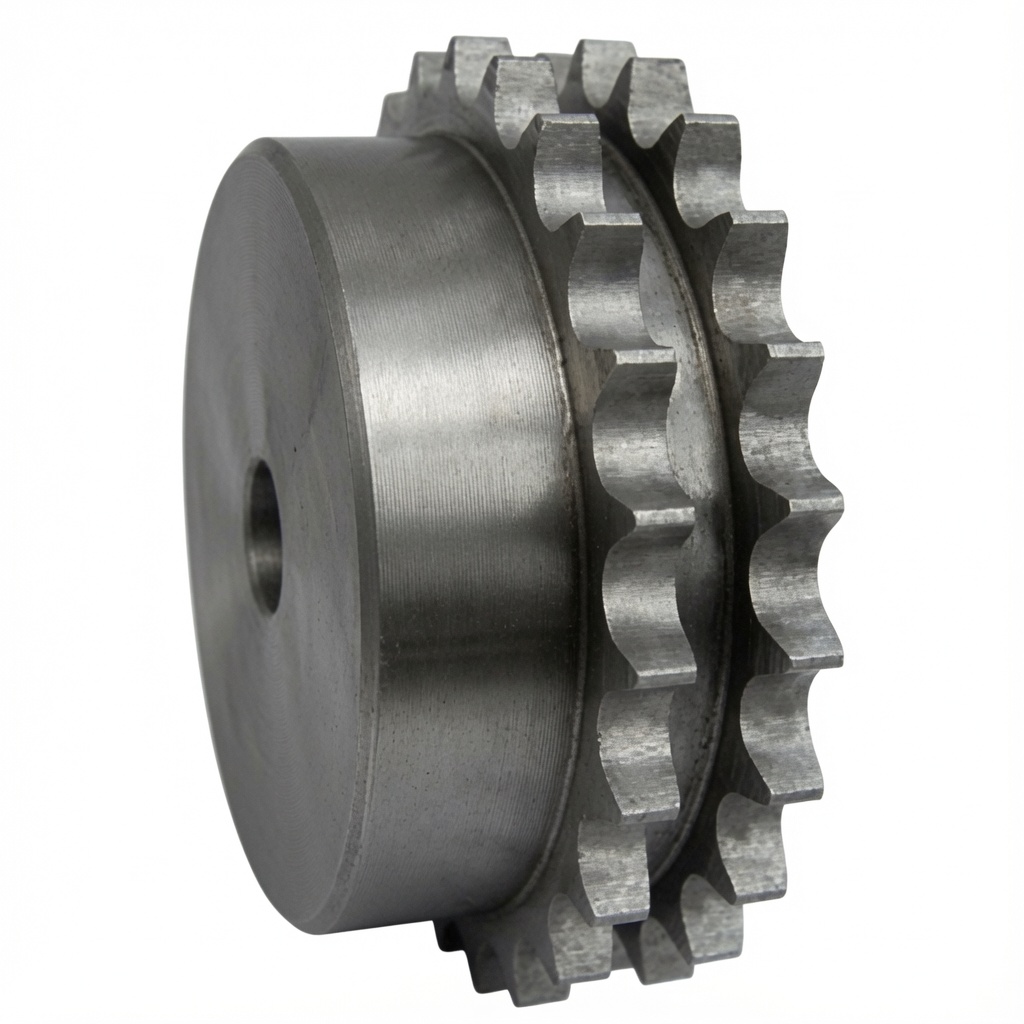
Carbon steel — specifically medium-carbon C45 grade (equivalent to SAE 1045 in North American standards) — is the dominant material for industrial chain sprockets in the majority of global markets. The reason is straightforward: C45 steel, when properly heat treated, provides a combination of tooth-surface hardness, core toughness, and fatigue resistance that no other common sprocket material matches at competitive cost. High-frequency induction hardening of C45 sprocket teeth achieves 40–50 HRC on the tooth flanks while leaving the hub and body at Rockwell B 90–95, providing hard wear-resistant teeth on a tough, impact-resistant hub.
The structural performance of C45 hardened steel sprockets — measured in terms of allowable chain load, fatigue life under cyclic loading, and resistance to shock-induced tooth fracture — exceeds that of 304 stainless steel at equivalent dimensions. This performance advantage makes C45 hardened steel the preferred choice for high-load drives, shock-load applications, and the main power transmission drives on agricultural machinery, mining equipment, and heavy industrial conveyors.
Stainless Steel Sprockets: Performance Profile
304-grade stainless steel sprockets achieve their primary advantage through the inherent corrosion resistance of the austenitic stainless steel alloy — an 18–20% chromium, 8–10.5% nickel composition that forms a self-healing chromium-oxide passive film on all exposed surfaces, including the tooth faces and the bore. Unlike a surface coating, this passive film cannot be worn through at the tooth-roller contact zone; it regenerates whenever the surface is exposed to oxygen. Stainless steel sprockets in 304 grade are the standard specification for food processing, pharmaceutical, wash-down, and corrosive-environment applications across the global market.
The trade-off is mechanical: 304 stainless steel has a lower yield strength (210 MPa min) and lower surface hardness (Rb 80–90) than properly hardened C45 steel (600+ MPa tooth-face hardness at 40–50 HRC). A 304 stainless sprocket carrying the same chain load as a C45 hardened sprocket will accumulate tooth-face wear approximately 3–5 times faster, given equal contact stress conditions. This is an acceptable trade in environments where corrosion is the dominant failure mechanism — but in abrasive or very high-load environments where mechanical wear governs service life, the lower hardness of stainless is a genuine performance limitation.
Head-to-Head Comparison: All Performance Dimensions
| Performance Dimension | C45 Carbon Steel (HF-Quenched) | 304 Stainless Steel (Passivated) |
|---|---|---|
| Tooth surface hardness | 40–50 HRC (hardened flank) | Rb 80–90 (not hardenable by HF) |
| Tensile strength | 600–800 MPa (post-hardening) | 515 MPa minimum |
| Fatigue life under cyclic load | Excellent — hardened case, tough core | Good — lower load capacity at same size |
| Shock load resistance | High — tough C45 core below hardened case | Moderate — austenitic SS is tougher than hardened C45 but at lower strength |
| Corrosion resistance (atmospheric) | Poor — rusts without coating or lubrication | Excellent — passive film self-heals |
| Corrosion resistance (CIP chemicals) | Very poor — corrosion in hours to days | Excellent after passivation |
| Corrosion resistance (salt spray) | Very poor | Good (304) to Excellent (316L) |
| Food-contact compliance | Not compliant without surface treatment | Compliant with ASTM A967 passivation |
| Abrasion resistance (grit/sand) | Excellent — hard tooth surface resists abrasion | Moderate — softer tooth surface wears faster in grit |
| Surface treatment required | Yes: zinc plate, black oxide, or HF quench only | Yes: passivation (ASTM A967) after machining |
| Maximum service temperature | ~300 °C continuous | ~300 °C continuous |
| Relative cost (same dimensions) | Lower (reference) | 30–60% higher |
| Best environment | Dry, lubricated, indoor or agricultural outdoor | Wet, wash-down, food-grade, chemical, marine |
Total Cost of Ownership: The Correct Basis for the Decision
The most common mistake in material selection for sprockets is comparing purchase price rather than total cost of ownership. In environments where carbon steel corrodes, the real cost of specifying C45 over stainless steel includes: accelerated replacement frequency, contamination risk penalties in food or pharmaceutical facilities, corrosion-related downtime, and the environmental disposal cost of rust-contaminated lubricant. In environments where corrosion is not a factor, the real cost of specifying stainless over C45 includes: the material premium, the longer lead time for stainless, and the lower abrasion resistance in grit-contaminated drives.
The 316L Upgrade: When 304 Stainless Is Not Enough
Standard 304 stainless steel performs well in most corrosive environments encountered in food processing, pharmaceutical, and general wash-down applications. However, two specific conditions cause 304 to fail through pitting corrosion: high chloride concentrations (above approximately 200 ppm of chlorine in cleaning solutions, or salt-spray coastal environments) and prolonged contact with certain acids including phosphoric acid and some cleaning formulations. In these conditions, DIN stainless sprockets in 316L grade — which adds 2–3% molybdenum to improve pitting resistance — should be specified instead of 304.
Decision Framework: Which Material for Your Application?
Hangzhou Ever-Power manufactures stainless steel, carbon steel, and custom chain sprockets for global industrial buyers. Low MOQ, full documentation, fast lead times from Hangzhou, China.
SHENHUA ROAD, HANGZHOU, CHINA | +86-571-88220653