
Pitch diameter is the engineering dimension that connects sprocket geometry to drive performance. It is used in every chain-speed calculation, every centre-distance formula, and every speed-ratio determination for chain drives. Yet pitch diameter is invisible on the finished sprocket — it cannot be measured directly with callipers or a tape measure — which creates a paradox for engineers: the most important dimension for drive calculations is the one dimension that does not appear on the physical component. This article explains what pitch diameter is, why it matters, and exactly how to calculate it for any chain-sprocket combination.
What Is Pitch Diameter? A Geometric Definition
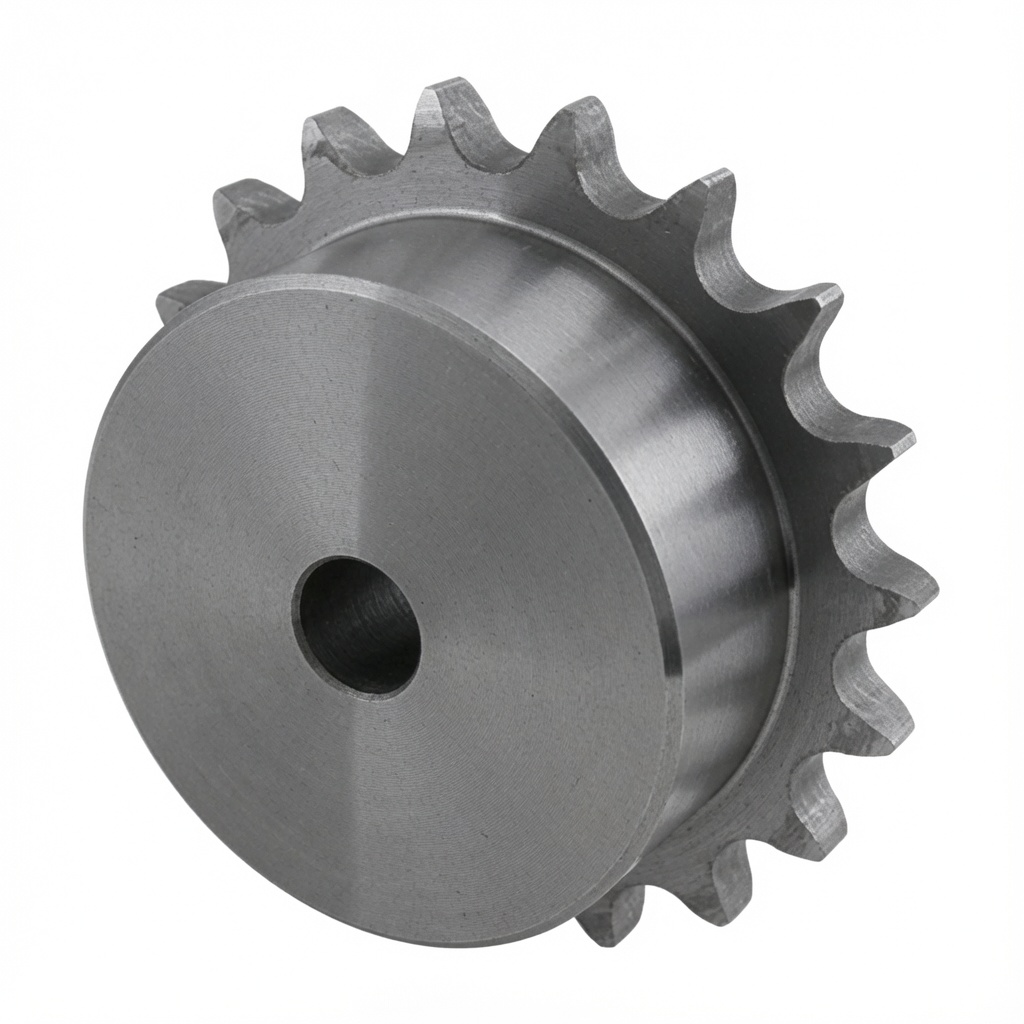
The pitch diameter (Dp) of a sprocket is the diameter of the pitch circle — an imaginary circle that passes through the centres of the chain rollers as they seat in the sprocket tooth pockets. When a roller chain wraps around a sprocket and the rollers are seated in the tooth gullets, each roller centre lies on the pitch circle. The pitch diameter is the diameter of the circle defined by these roller centre positions.
The pitch circle is a theoretical construction, not a physical surface. It lies within the body of the tooth profile, somewhere between the root circle (bottom of the tooth pockets) and the outside diameter (tooth tips). The exact position depends on the pitch and tooth count — for a sprocket with many teeth, the pitch circle is close to the outside diameter; for a sprocket with few teeth, the pitch circle is noticeably smaller than the outside diameter.
The Pitch Diameter Formula and Its Derivation
The Standard Formula
The pitch diameter of any sprocket is calculated using a single formula that relates three quantities: pitch (p), tooth count (N), and the geometry of a regular polygon:
Why This Formula Works
A sprocket with N teeth is geometrically equivalent to a regular polygon with N sides, where each side length equals the chain pitch p. The pitch circle is the circumscribed circle of this polygon — the circle that passes through all N corners (which correspond to the roller centres). The relationship between the side of a regular N-gon and its circumscribed circle radius (R = p / (2 × sin(180° / N))) yields the pitch diameter formula above when doubled: Dp = p / sin(180° / N).
This formula is exact — not an approximation. It produces the precise pitch diameter for any combination of pitch and tooth count, regardless of whether the result is a round number. Sprocket catalogue dimensions are calculated with this formula and rounded to three decimal places for practical use.
Worked Examples: Calculating Pitch Diameter for Common Sprockets
| Sprocket | Chain | Pitch (p) | Teeth (N) | sin(180°/N) | Pitch Diameter (Dp) |
|---|---|---|---|---|---|
| 17T No.40 | ANSI #40 | 0.500″ | 17 | sin(10.588°) = 0.1837 | 0.500/0.1837 = 2.722″ |
| 20T No.40 | ANSI #40 | 0.500″ | 20 | sin(9.000°) = 0.1564 | 0.500/0.1564 = 3.197″ |
| 25T No.40 | ANSI #40 | 0.500″ | 25 | sin(7.200°) = 0.1253 | 0.500/0.1253 = 3.990″ |
| 17T No.60 | ANSI #60 | 0.750″ | 17 | sin(10.588°) = 0.1837 | 0.750/0.1837 = 4.083″ |
| 21T 08B | BS/DIN 08B | 12.7 mm | 21 | sin(8.571°) = 0.1490 | 12.7/0.1490 = 85.2 mm |
| 25T 12B | BS/DIN 12B | 19.05 mm | 25 | sin(7.200°) = 0.1253 | 19.05/0.1253 = 152.0 mm |
How Pitch Diameter Is Used in Drive Calculations
Pitch diameter is the foundation of every quantitative calculation in chain drive design. Engineers working with conveyor chain sprockets use pitch diameter constantly in four primary types of calculations.
1. Speed Ratio Calculation
The speed ratio of a chain drive equals the ratio of the pitch diameters of the two sprockets, which in turn equals the ratio of their tooth counts (since both sprockets have the same pitch):
2. Chain Speed Calculation
Chain speed (metres per minute or feet per minute) is calculated from the driver sprocket pitch diameter and rotational speed:
Equivalently, since pitch × teeth = π × Dp (a geometric identity for a regular polygon approximated at large N): Chain Speed ≈ p × N × RPM. This simpler form is accurate for tooth counts above 17 and is the form used in most practical chain-speed calculations.
3. Centre Distance and Chain Length
The centre distance between two sprocket shafts is most conveniently calculated using pitch diameters rather than outside diameters. The standard chain-length formula uses pitch diameter to determine the chain wrap arc on each sprocket and the straight-span length between them. For a quick approximation when detailed calculation is not needed:
Pitch Diameter vs. Outside Diameter: Why the Difference Matters
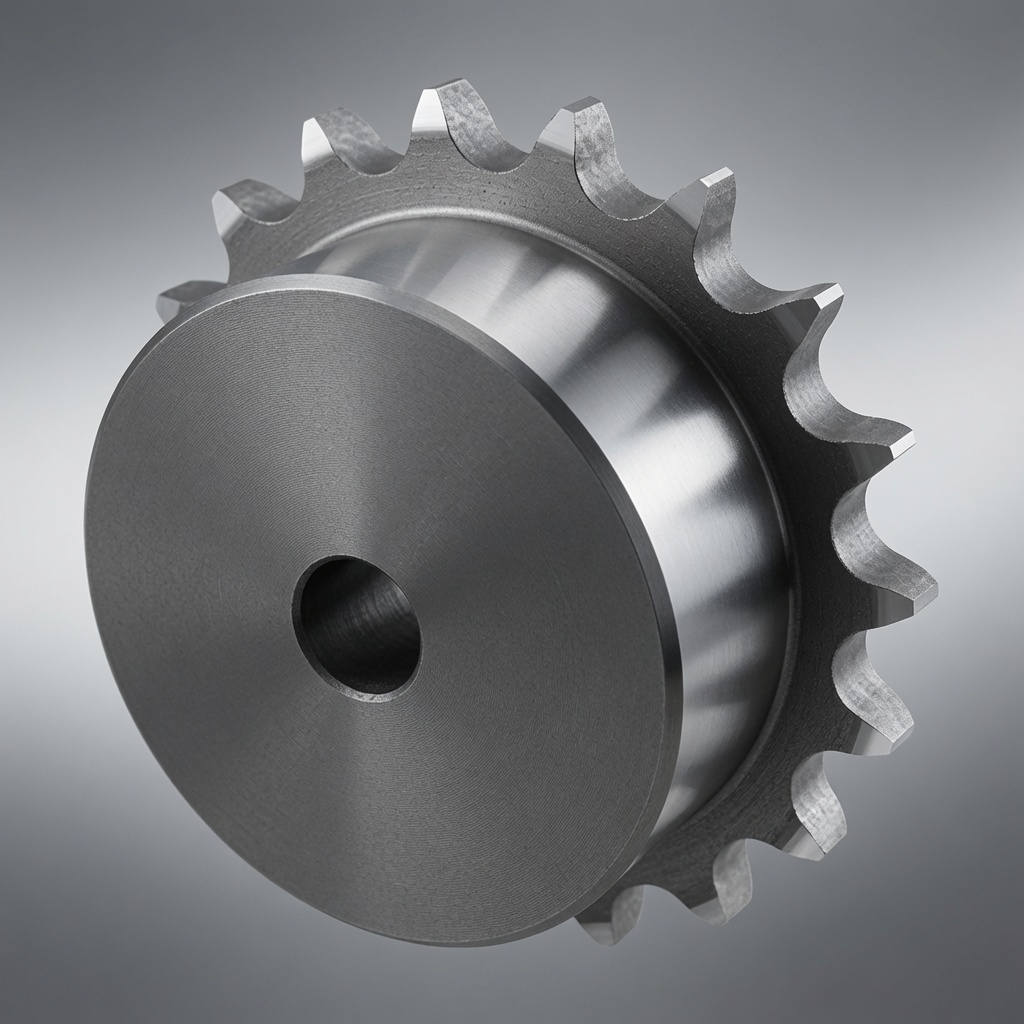
Engineers who are new to chain drive calculations sometimes confuse pitch diameter (Dp) with outside diameter (Do). This confusion produces errors in centre distance calculations, incorrect chain-length determinations, and misidentification of worn sprockets. ANSI roller chain sprockets catalogues list both dimensions; knowing which to use in which calculation is essential.
| Dimension | Symbol | What It Measures | Used For |
|---|---|---|---|
| Pitch Diameter | Dp | Diameter of roller-centre circle during engagement | Speed ratio, chain speed, centre distance, chain length calculations |
| Outside Diameter | Do | Diameter measured at tooth tips | Clearance checking, physical measurement on finished sprocket, hub-to-tip dimension verification |
| Root Diameter | Dr | Diameter at the bottom of tooth pockets | Minimum sprocket body size for strength calculation |
| Hub Diameter | N / Dh | Outer diameter of hub | Shaft bearing and clearance design |
Pitch Diameter in Sprocket Catalogues: How to Read the Numbers
Most stainless steel sprockets catalogue entries list both pitch diameter (Dp) and outside diameter (Do), along with bore range, hub length, and weight. The pitch diameter is calculated from the formula above and is listed to three decimal places in most catalogues. The outside diameter is typically listed to two or three decimal places. Neither can be used as a substitute for the other in engineering calculations — use Dp for drive geometry calculations and Do for physical clearance checks.
When a sprocket drawing is provided for a custom order, the pitch diameter appears as a reference dimension (often with REF or a parenthetical notation) because it is a calculated value rather than a directly measurable or toleranced surface. The toleranced features are the bore (H7 or equivalent), the hub OD, and the outside diameter (typically within ±0.010″ or ±0.25 mm). The tooth form is controlled by the hobbing programme and verified by first-article optical comparator inspection — not by a dimension block on the drawing.
How to Find Pitch Diameter for an Unmarked or Unknown Sprocket
When a sprocket has no markings and no catalogue entry is available, pitch diameter can be determined through a three-step process. This procedure is useful for identifying replacement sprockets for legacy equipment with incomplete documentation.
Hangzhou Ever-Power manufactures stainless steel, carbon steel, and custom sprockets for global industrial buyers. Low MOQ, full documentation, fast lead times.
SHENHUA ROAD, HANGZHOU, CHINA | +86-571-88220653